
By Christopher Dill
Affiliate & Referral Disclosure: This article contains affiliate and referral links, including links to Crosslist and some of the resale platforms discussed below. If you sign up or make a qualifying purchase through one of my links, I may receive a commission, credit, or referral reward at no additional cost to you. In some cases, you may also receive a signup discount, credit, or other promotional benefit. I personally use the platforms discussed in this article, and all opinions and experiences shared here are my own.
If you sell online on more than one marketplace, you already know how repetitive the process can get.
Take the pictures. Write the title. Write the description. Choose the category. Enter the condition. Set the price. Enter the shipping information. Publish the listing.
Then go to another marketplace and do basically the same thing all over again.
I know because that’s exactly what I used to do.
Before I started using Crosslist, I was hesitant to pay for a monthly subscription just to do something I technically could do myself. I figured I could save the money, manually list my inventory on every platform, and keep moving.
And I did.
I actually got pretty fast at it.
But eventually I realized something: I was saving a little money while wasting a lot of time.
And time is one thing we don’t get back.
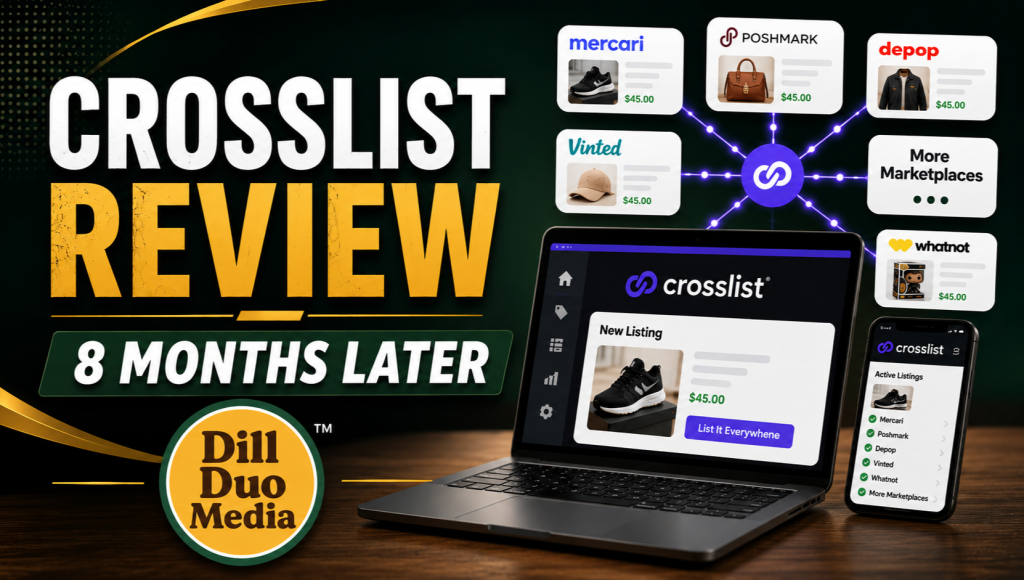
After using Crosslist for about eight months, I can say that signing up was one of the better decisions I’ve made for my resale operation. It didn’t magically make every item sell, and it doesn’t eliminate every bit of work involved in reselling. What it did was make it much easier for me to put my inventory in front of buyers across multiple marketplaces without repeatedly rebuilding the same listings.
That changed the way I run my resale business.
Why I Wanted My Inventory on More Marketplaces
One of the biggest lessons I’ve learned from reselling is that you never really know where your buyer is going to be.
An item that gets almost no attention on one marketplace might sell quickly somewhere else.
That’s why I don’t like depending entirely on one resale platform.
I’ve had months where platforms like Vinted and Depop were moving inventory for me while Mercari, Poshmark, or Whatnot were slower. I’ve personally had Vinted and Depop combine for around 60 sales in a month while some of the platforms I had been using longer weren’t producing nearly as much activity.
That’s important.
If all of that inventory had only been sitting on one or two of my older marketplaces, I could have looked at a slow month and assumed people simply weren’t interested in what I was selling.
That wasn’t necessarily true.
The buyers were somewhere else.
Cross-listing gives me a way to put the same available inventory in front of more people.
I can’t control which marketplace is going to be hot for my particular inventory this month. I can’t control whether buyers are spending more time on Mercari, Poshmark, Depop, Vinted, Whatnot, or somewhere else.
What I can control is how many opportunities I give my inventory to be discovered.
That’s probably the biggest reason I’ve stayed with Crosslist.
Crosslist describes its own mission similarly: helping online sellers reach more buyers across more marketplaces without spending all their time duplicating administrative work.
Why I Didn’t Use Crosslist at First
My biggest objection was simple:
Why should I pay every month for something I can do myself?
That’s a fair question, especially when you’re running a resale business where every expense matters.
So for a while, I did exactly that.
I manually listed the same inventory across different marketplaces. Once you’ve done enough listings, you can get pretty quick at copying information, moving pictures around, changing categories, adjusting titles, and filling out the different forms.
But “pretty quick” multiplied by hundreds of listings is still a lot of time.
Eventually I had to look at the subscription differently.
I wasn’t really paying Crosslist because I was incapable of manually creating another listing.
I was paying to get my time back.
If you’re spending hours repeatedly entering information you’ve already entered somewhere else, that time has a value.
For me, roughly $30 a month at the entry level made sense if the tool could eliminate enough repetitive work and make it practical for me to expand onto marketplaces I otherwise might not bother using.
Once I looked at it that way, the calculation changed.
I Researched the Competition Before Choosing Crosslist
I didn’t immediately sign up for the first cross-listing service I found.
Before choosing Crosslist, I looked at competing tools, compared prices, read reviews, and tried to figure out which service made the most sense for the way I actually sell.
I probably spent a couple of weeks looking into it before finally pulling the trigger.
After roughly eight months of actually using Crosslist in my resale operation, I feel like I made the right choice for me.
That’s an important distinction.
I’m not saying every reseller on the internet has to use the exact same software I use. Different sellers have different inventory, different volumes, different marketplaces, and different workflows.
I’m telling you what I chose after doing my research — and what happened after I started actually using it.
The Feature That Matters Most to Me Is Simple: List Once, Reach More Buyers
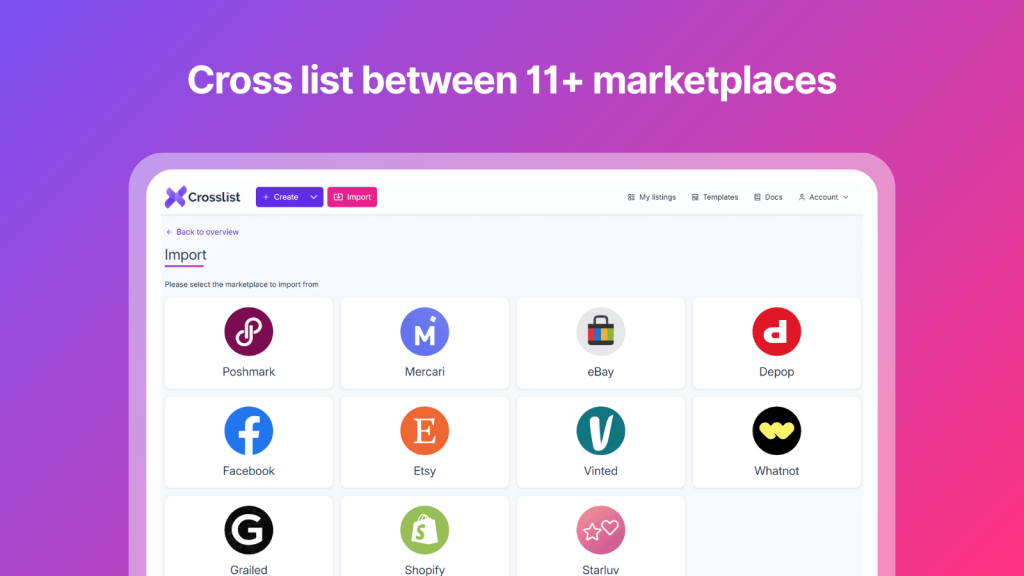
Crosslist supports selling across multiple online marketplaces and e-commerce platforms.
But the number of supported platforms isn’t really the important part to me.
The important part is what that allows me to do.
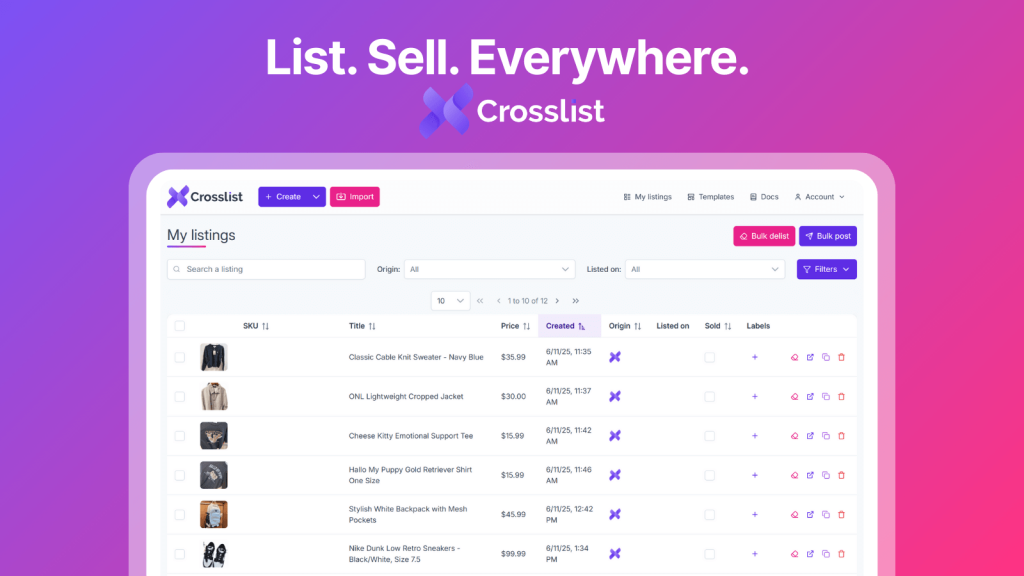
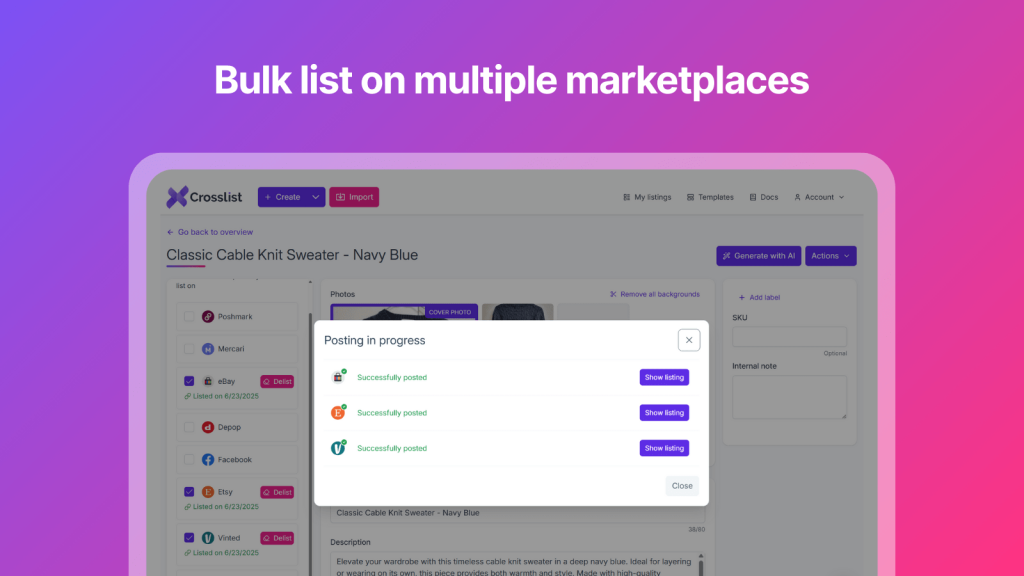
I can take inventory I already have listed, bring those listings into Crosslist, and use that information to publish the products across additional marketplaces instead of manually rebuilding everything from scratch.
That’s huge when you have a lot of inventory.
It also made me more willing to try additional resale platforms.
Before Crosslist, signing up for another marketplace meant I immediately thought about all the work involved.
“Great. Now I’ve got another place where I have to recreate all these listings.”
Once I had Crosslist, adding another marketplace wasn’t nearly as intimidating.
And ironically, some of those newer platforms ended up producing more sales for me than platforms I’d been using much longer.
That’s something I wouldn’t overlook if you’re a reseller.
Sometimes expanding isn’t about finding more inventory.
Sometimes it’s about getting the inventory you already own in front of more people.
Why I Use the Lowest-Priced Tier
Another thing I learned is that you don’t necessarily need the biggest subscription available just because it has more features.
I actually started on a higher Crosslist tier.
Once I understood my own usage better, I moved down.
I currently use the lowest-priced option because, in a typical month, I’m probably going to add 200 items or fewer. For the way I operate right now, I don’t need to pay for capacity I’m not consistently using.
Higher tiers can make sense for sellers with larger listing volume or sellers who want additional automation.
One example is automatic delisting.
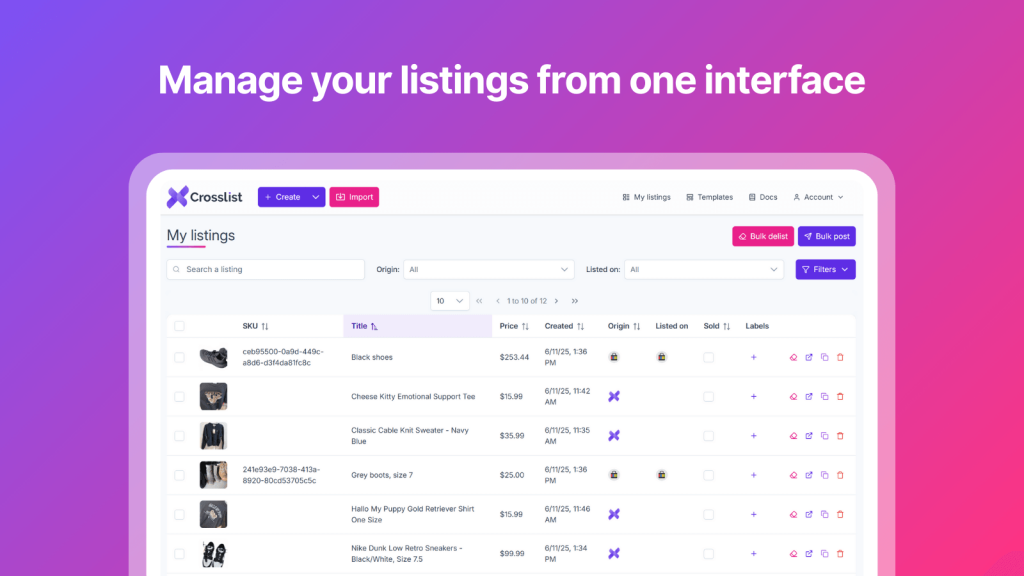
When something sells, the marketplace where it sold is obviously going to notify me. With my current setup, I can go into Crosslist and manually delist that item from the other marketplaces where I have it listed.
Higher-level features can automate more of that process.
Personally, I don’t mind doing that part manually.
Actually, I like having that little bit of control over my inventory. I know something sold, I go in, I deal with it, and I know exactly what happened.
Another seller may look at that and say, “Nope. I want as much of this automated as possible.”
That’s perfectly reasonable too.
Choose the plan based on the way you actually operate, not just the plan with the longest feature list.
My Biggest Cross-Listing Tip: Use Small Batches
This is probably the most important practical advice I can give somebody who decides to start cross-listing:
Don’t dump 100 listings onto every marketplace at once just because you can.
I learned this through experience.
When I was getting started, I tried moving large batches of inventory. In particular, I ran into situations with Poshmark where Crosslist indicated that listings had been posted, but some of those listings weren’t actually appearing in my Poshmark store the way I expected.
That created rework.
And that’s exactly what I was trying to eliminate in the first place.
I want to be clear about something here: I don’t consider this a general limitation of cross-listing, because I haven’t experienced the same issue across all of the resale platforms I use.
It was something I encountered with one platform while batch posting.
That’s why my recommendation now is simple.
Work in smaller batches.
I generally think somewhere around 20 to 40 listings at a time is much more manageable than trying to throw 100 listings everywhere at once.
Post the batch.
Give the marketplaces time to process everything.
Make sure your listings are appearing correctly.
Then move on to the next batch.
Could you potentially push larger batches? Sure.
But I’d rather spend a little more time verifying smaller groups than create a bunch of unnecessary work for myself later.
That’s just how I handle it after learning from my own experience.
Crosslist Doesn’t Replace Managing Your Business
I think this distinction matters.
Crosslist is a tool.
It isn’t your business manager.
I still pay attention to what sells. I still know which platforms are performing well for me. I still manage my inventory. I still make decisions about pricing, listings, photographs, descriptions, and where I want to sell.
What Crosslist removes is a lot of the repetitive work between those decisions.
That’s why I don’t necessarily want every possible task automated.
Automation is useful, but control is useful too.
For my particular operation, I’ve found a middle ground that works: automate enough of the repetitive listing process to save substantial time while continuing to personally manage the parts of my inventory that I want to control.
Does Crosslist Actually Pay for Itself?
This was the question I cared about when I started.
Forget the feature list.
Forget the marketing.
Am I going to get enough value out of this thing to justify another monthly subscription?
For me, yes.
And I don’t even calculate the value strictly based on whether Crosslist itself “caused” a certain number of sales.
That’s difficult to measure anyway.
I look at two things:
Time and exposure.
If I’m saving hours that I would otherwise spend recreating listings, that has value.
If using that saved time allows me to put more inventory on more marketplaces, that gives those items more opportunities to sell.
And if being able to efficiently manage multiple marketplaces allows me to discover platforms where my particular inventory performs better, that’s potentially even more valuable.
That’s exactly what happened to me.
Some of the newer platforms I expanded onto became significant sources of sales.
So when I look at roughly $30 a month for the tier that fits my current operation, I’m not simply asking:
“Did this software directly make me $30?”
I’m asking:
“How much time did it save me, how much additional exposure did it give my inventory, and what opportunities did that make possible?”
For me, the answer easily justifies the cost.
Who I Think Crosslist Makes the Most Sense For
I don’t think everybody who sells one random item online needs a monthly cross-listing subscription.
If you have five things sitting around the house that you’re trying to get rid of, manually posting them might make perfect sense.
But the equation changes when you’re operating actual resale inventory.
If you’re regularly listing products, maintaining inventory across several marketplaces, or avoiding additional marketplaces because you don’t want to recreate hundreds of listings, then I think a tool like Crosslist becomes much easier to justify.
The larger your active inventory becomes, the more valuable your time becomes.
And once you realize that the exact same item can sit quietly on one platform while attracting a buyer somewhere else, having access to multiple marketplaces starts making even more sense.
What I Wish I Had Done Differently
I would have started sooner.
That’s probably the simplest way I can put it.
I spent a lot of time manually recreating listings because I was trying to avoid paying for software.
At the time, that felt financially responsible.
Looking back, I was focusing on the obvious cost — the subscription — while ignoring the less obvious cost: my time.
Once I finally tried Crosslist and saw how much repetitive work it eliminated, my reaction was basically:
Why haven’t I always been doing this?
That doesn’t mean I regret learning how to list manually. Knowing how every marketplace works individually is valuable.
But once you know how to do the work, there’s nothing particularly valuable about doing the same work over and over again when a tool can handle much of that repetition for you.
My Recommendation After About Eight Months
After approximately eight months of using Crosslist, I’m still using it.
That probably tells you more than anything else in this review.
I researched the alternatives before signing up. I started with a higher tier. I figured out which features I actually needed. I moved to the lower-priced tier that better matched my listing volume, and I’ve incorporated Crosslist into the way I manage my resale inventory.
The biggest benefits for me have been straightforward:
- I save time compared with manually recreating listings.
- I can put the same inventory in front of buyers on multiple marketplaces.
- I’m less dependent on whether one particular resale platform happens to be slow.
- It made expanding onto additional marketplaces much easier.
- I can import existing inventory and distribute it without starting every listing from zero.
- I can still manually manage things like delisting when I want that control.
And my biggest practical recommendation remains the same:
Cross-list in smaller batches.
Don’t get excited and blast 100 listings everywhere just because the software makes it possible. Start with 20 or 40, verify everything is appearing correctly, and keep moving.
It’s a little more deliberate, but it can save you from unnecessary rework.
Want to Try Crosslist?
If you’re currently copying the same listings manually from one marketplace to another, I understand why you might hesitate to add another monthly expense.
I did too.
But eventually I realized that I wasn’t really deciding between “free” and “paid.”
I was deciding whether I wanted to keep paying for cross-listing with my time.
For the way I run my resale operation, Crosslist has been worth it.
If you decide you want to try it, you can use my Crosslist affiliate link. Using my link may also qualify you for Crosslist’s current new-customer promotional offer. Because affiliate discounts and program terms can change, check the offer shown when you follow the link for the current details.

Crosslist’s current brand materials also advertise a 3-day money-back guarantee for trying the service risk-free.
I’m an independent reseller and Crosslist user, not an employee or official representative of Crosslist. I’m recommending it because it’s a tool I actually use in my own resale operation.
And if there’s one thing I’d tell another reseller who is still manually copying listings from marketplace to marketplace, it’s this:
Your inventory can’t sell to buyers who never see it.
Getting in front of more buyers was the reason I wanted to cross-list in the first place.
Getting my time back is the reason I kept doing it.
Want to Try Other Resale Marketplaces?
Cross-listing made it much easier for me to expand onto additional marketplaces and get my inventory in front of more potential buyers. If you’re thinking about adding another selling platform, below are some of the marketplaces I personally use in my own resale business.
I’ve included my referral links where they’re available, along with what you can currently receive for signing up through them. Referral offers can change, so always check the offer shown when you follow the link for the most current terms.
Try Whatnot
Whatnot has a seller referral program for people interested in joining the platform and selling their own inventory.
New sellers can currently earn a bonus of up to $150 during their first week.
If you join through my seller referral link, I can also earn a $100 referral reward after you reach $100 in total sales and sell to five different buyers.
Try Mercari
Mercari offers referral rewards whether the person you invite starts out buying or selling.
If your referral makes their first purchase, they save $10 and I receive $10.
If they start selling, they can save $10 after earning their first $100, and I receive another $10.
That means I can earn up to $20 for each qualifying referral, while a new user can receive up to $20 in savings depending on how they use Mercari.
Try Poshmark
Poshmark’s referral program gives both you and me a reward when you join through my referral.
You’ll receive $10 when you join using my referral code.
Once your first order is delivered, I’ll receive a $10 referral reward.
If you’re interested in trying Poshmark, click the heading above to sign up through my referral.
Try Depop
I also sell on Depop. Depop doesn’t currently provide me with a referral offer, but you can visit my Depop storefront to see the platform and the type of inventory I sell there.
If you’re not already using Depop and decide it’s a marketplace you’d like to try, you can also sign up directly through the platform.
Try Vinted
Vinted also has a referral program that rewards both you and me when you start selling through my referral.
After you list your first 3 items, you’ll receive $5 to spend on Vinted, and I’ll receive $5 as well.
Then, after you make your first sale, you’ll receive another $10 and I’ll receive another $10.
That means we can each receive up to $15 in Vinted credit when you complete both steps.