
By Christopher Dill
Resellers spend a lot of time learning how to spot bargains. That skill matters, but there is another skill that can be just as important: knowing when not to buy.
Reseller impulse buying can look surprisingly responsible in the moment because we can give the purchase a business justification.
The item is cheap. The potential margin looks good. The inventory may be hard to find. It feels like passing on it would mean losing money.
But a profitable-looking purchase can still be a bad business decision if it adds to an already large backlog, ties up cash, consumes storage space, or keeps you sourcing when you should be listing and selling.
A Good Deal Is Not the Same as a Good Purchase
The easiest question to ask while sourcing is:
Can I sell this for more than I am paying?
That question matters, but it is incomplete.
A better decision also considers how quickly the item is likely to sell, how much work it requires, whether you already have similar inventory, how much unlisted merchandise is waiting, and whether buying it will leave enough cash available for other needs.
An item can offer an excellent theoretical margin and still be the wrong purchase today.
That distinction matters because reselling is not just about buying low.
Eventually, everything you buy has to move through the rest of the business.
Potential Profit Is Not Realized Profit
It is easy to mentally spend profit before an item has even been listed.
Buy something cheaply, estimate a much higher selling price, and suddenly it can feel as though the difference has already been earned.
It hasn’t.
Inventory still has to be inspected, cleaned when necessary, photographed, researched, listed, cross-listed when appropriate, stored, sold, packed, and shipped.
Some items will sell quickly. Others may sit for months. Some may eventually require a price reduction.
Until a sale actually happens, the projected margin is potential.
It isn’t cash.
Reseller Impulse Buying Can Turn Inventory Into a Capital Trap
Buying inventory converts liquid cash into merchandise.
That can be productive when the merchandise moves through the sales pipeline. It becomes a problem when purchases accumulate faster than listings and sales.
A reseller can own hundreds or thousands of dollars in potential retail value while still feeling short on cash because too much money is sitting in boxes, bins, closets, shelves, or storage.
The issue is not necessarily that the inventory is bad.
The issue is that capital has been committed before the existing inventory has had a reasonable opportunity to turn back into cash.
And another great deal does not automatically solve that problem.
Sometimes it makes it bigger.
Sourcing Can Feel More Productive Than Listing
Sourcing is exciting.
Finding an underpriced item creates an immediate sense of opportunity. Listing is usually slower and more repetitive.
That difference can create a dangerous habit: continuing to hunt for the next deal while the previous deals remain untouched.
The result can be a business that is very good at acquiring inventory but much less effective at converting that inventory into sales.
A healthy resale operation needs both sides.
Sourcing creates opportunity.
Listing creates availability.
Selling creates cash flow.
If one part consistently outruns the others, the system becomes unbalanced.
Your Backlog Changes the Value of the Next Deal
The same sourcing opportunity can be a smart purchase for one reseller and an unnecessary purchase for another.
If your current inventory is largely listed, organized, and selling, additional stock may be exactly what the business needs.
If you already have a large unlisted backlog, the next purchase adds more labor before it adds revenue.
That is why the purchase price alone cannot determine whether a deal is good.
Your existing workload matters.
Your storage situation matters.
Your available cash matters.
And the amount of inventory already waiting for your attention matters.
Cash Flow Matters More Than the Thrill of the Margin
A reseller also needs money available outside of inventory.
There may be shipping supplies, business tools, operating expenses, taxes, transportation costs, or simply a better sourcing opportunity tomorrow.
Spending available cash every time something appears underpriced can leave a business inventory-rich and cash-poor.
That is one of the traps of looking only at potential margin.
A $5 purchase that might eventually sell for $30 looks great in isolation.
But if you already have piles of other $5 purchases waiting to be photographed and listed, the question changes.
Do you need another potential $30 sale?
Or do you need to finish the work attached to the inventory you already own?
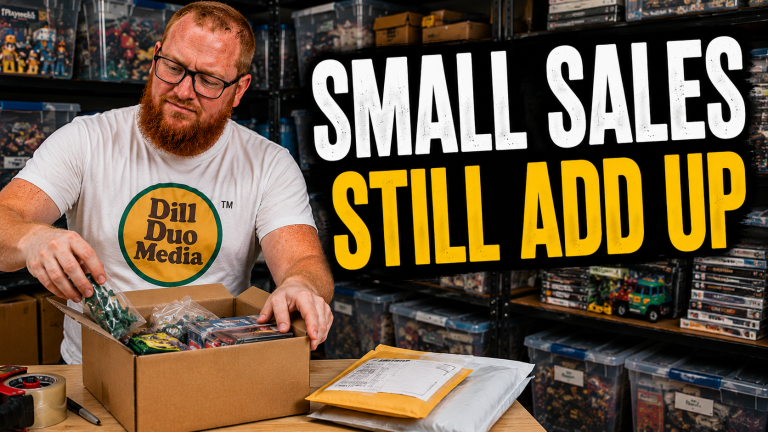
Getting existing inventory listed and sold can matter more than finding another bargain. That’s especially true when small resale sales can still make business sense because low-cost inventory doesn’t necessarily need one huge sale to contribute to the business.
Sometimes the financially disciplined decision is to let somebody else get the deal.
There will be other inventory.
Create Rules That Slow Down Impulse Sourcing
Reseller impulse buying becomes easier to control when the decision is governed by rules instead of excitement.
A reseller might set a sourcing budget, pause new purchases when the unlisted backlog reaches a certain size, require a minimum expected margin, prioritize categories with proven sell-through, or finish listing one batch before buying another.
The exact rule will vary by business.
What matters is creating a point where you have to evaluate the purchase instead of automatically reacting to the word deal.
It can also help to ask a simple question before buying:
If this exact item were still available tomorrow, would I still want it after looking at everything I already need to list?
That question forces the new opportunity to compete with the reality of the business you already have.
Passing on Inventory Can Be a Business Win
Resellers are trained to notice missed profit.
That makes passing on an inexpensive item uncomfortable, especially when somebody else buys it shortly afterward.
But not every missed purchase is missed profit.
Sometimes you protected your cash.
Sometimes you avoided another month of backlog.
Sometimes you kept storage space available for better inventory.
Sometimes you avoided adding several more steps to an already crowded workload.
And sometimes you simply chose to finish the work you had already paid for.
There is value in that.
The Goal Isn’t to Own the Most Inventory
The goal of reselling is not to own the most inventory.
It is not to find every bargain.
And it is not to calculate the largest pile of theoretical profit sitting around the house.
The goal is to operate a business that converts inventory into sustainable profit.
Buying inventory is only the beginning of that process.
Learning to spot opportunities matters.
Learning when to walk away from one can be just as valuable.