
By Christopher Dill
I spend a lot of time on the road. When you work that way, eating out can start feeling less like a choice and more like part of the job.
You leave the house, start taking orders, the day gets moving, and before you know it, it is 8, 9, 10, or even 11 at night. At that point, the idea that you are going home to cook a full meal sounds good in theory. In real life, you are tired and hungry, and the drive-through is right there.
That is the cycle I kept falling into.
I could eat better for a while, then work would get busy and convenience would take over again. Pizza, burgers, chili, sandwiches—whatever was quick and available.
I was not necessarily eating because I had decided I wanted restaurant food. A lot of the time, I was eating it because I had never made another plan for the day.
Eventually, I realized I was trying to solve the problem at the wrong end of the day.
Instead of expecting myself to cook after being out working all day, I needed to handle the food before I left the house.
The Problem Wasn’t Just the Food
It would be easy to turn this into an article about how fast food is bad and everybody should cook at home.
That is not useful advice for somebody whose workday happens in a car.
The real problem is that road work creates a convenience gap. If you do not bring food with you, sooner or later you have to solve hunger while you are already working.
That is when price, nutrition and even whether you are truly hungry can become secondary. You are making a decision in the middle of everything else.
A coupon pops up. A restaurant is nearby. You have ten minutes between orders. Something sounds good.
Then the same thing happens the next day.
For me, the better question became: How do I make the home option almost as convenient as the restaurant option?
Cook Before the Workday Starts
The biggest change I came up with was moving cooking to the morning.
If I am going to be out until late, nighttime cannot be my main cooking window. I already know what happens by then. I want to get home, sit down and be finished with the day.
If I get up around 7 and cook before I leave, the problem changes.
The food is already made. I can eat some at home, pack some for the road and put the rest in the refrigerator.
I am no longer asking myself at 8:30 at night what I am going to eat.
I answered that question before the first delivery.
That matters because meal prep does not have to mean spending Sunday filling twenty identical containers. It can simply mean cooking the food you were already going to eat at a time when you actually have the energy to do it.
Give the Week Some Structure
I also started looking at the week differently.
Instead of buying groceries and hoping I would figure out what to do with them later, I wanted the groceries to already have a job.
Taco Tuesday makes sense because tacos are quick and ground turkey can be cooked in the morning. Chili can have its own day because one pot can cover more than one meal. Pizza can be Friday instead of something that happens whenever an offer shows up or nobody feels like deciding what to eat.
The exact days are not the important part.
The important part is knowing what the food is for before buying it.
That helps with cost because I am not filling the refrigerator with good intentions. If I buy turkey, beans and tomatoes, I already know which meals they are going into.
Build Meals That Can Do More Than One Job
The best road-work foods are not necessarily fancy.
They are foods that can handle being cooked once and used more than once.
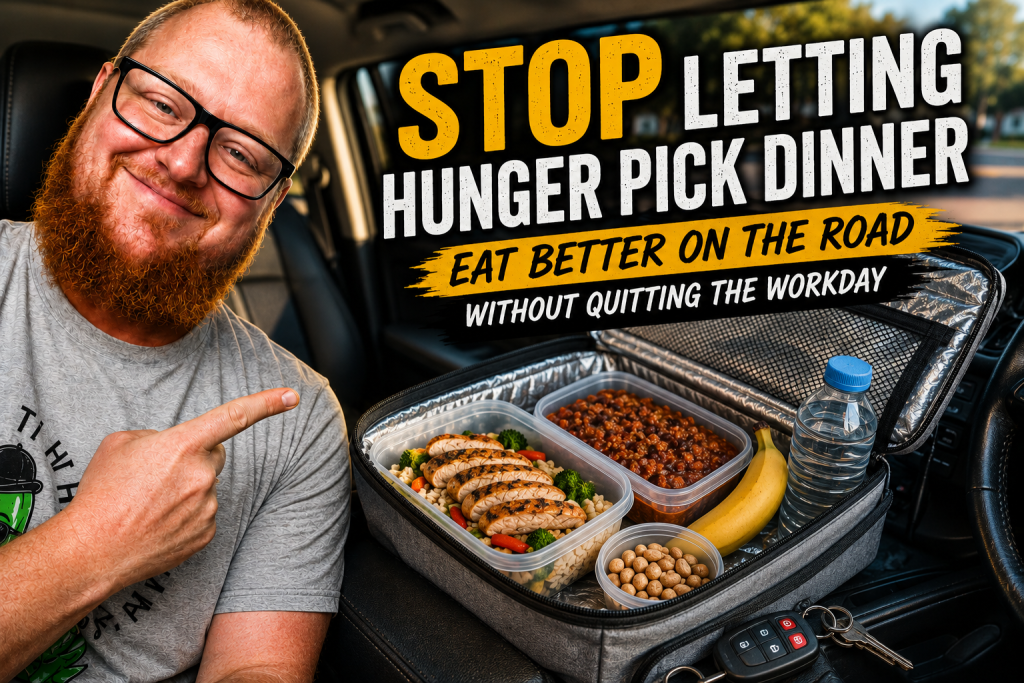
Chili works because I can eat a bowl at home, refrigerate the rest and have another serving later. Taco meat works because I can make tacos with it and use leftovers in another meal. Eggs are fast. Bananas and peanuts are easy to take with me.
That combination matters more to me than chasing some perfect meal plan.
I need protein, something filling, something I can transport, and food that does not require me to stop working every time I get hungry.
There is also a practical advantage to having more control over what goes into the food. A large majority of the sodium Americans consume comes from processed, prepackaged and restaurant foods. Cooking more meals yourself makes it easier to compare labels, choose lower-sodium ingredients and decide how much seasoning goes into the pot.
Do Not Confuse Planning With Restriction
I do not want a schedule that makes food miserable.
If Friday is pizza night, then Friday can be pizza night. The difference is that pizza has a place instead of becoming the automatic answer three times in one week.
The same thing goes for snacks.
There can still be cookies, chips, popcorn or whatever else is around the house. The meal schedule does not have to control every bite of food.
Its job is to keep the main meals from becoming an expensive daily improvisation.
That distinction is important.
A system that only works when life is perfect is not much of a system. I need something that still works when I am busy, when orders are coming in, when I am tired and when I would rather do almost anything besides cook at 10 at night.
Pack Food Before You Leave
Once the food is cooked, the next step is simple: take some of it with you.
That sounds obvious, but it changes the economics of the whole day.
If I already have food in the car, hunger does not automatically create a purchase. I can eat what I packed and keep working.
A banana or a handful of peanuts can bridge the gap when I am only a little hungry. A real meal can be waiting for when I need something more substantial.
The important part is keeping perishable food cold. Food-safety guidance calls for cold perishable food to remain at 40°F or below, and a properly packed cooler with ice or frozen cold packs can help accomplish that on the road.
Use Leftovers, But Use Them Safely
Batch cooking only saves money if the food actually gets eaten.
I like making enough chili for more than one day, but I also do not want to pretend leftovers last forever. Food-safety guidance generally recommends using refrigerated cooked leftovers within three to four days. If I know I will not get to something in that window, freezing it makes more sense than gambling with it.
The same planning applies before cooking.
If I open a larger package of raw ground turkey and know part of it will not be cooked within the next day or two, I would rather freeze that portion immediately and thaw it safely when I am ready for it. Current cold-storage guidance lists raw ground turkey at one to two days in the refrigerator.
That protects the food I paid for and keeps the weekly plan from turning into waste.
The Goal Is to Remove the Decision
What I am really trying to change is not one restaurant or one food.
It is the moment when I am sitting in the car late in the day trying to decide what to eat.
If I cook before leaving, know what the week looks like and bring food with me, that decision mostly disappears.
I can still eat out.
I can still have pizza.
I can change the schedule when life changes.
But eating out stops being the default simply because I ran out of time.
For somebody who works on the road, that is the part that matters. The meal plan has to fit around the work instead of pretending the work is not there.
The same principle applies to taking care of your body during long driving days. I’ve found that dealing with gig work driving stiffness also works better when the routine fits around the realities of the job instead of pretending those long hours behind the wheel do not exist.
Handle the food early, give the groceries a purpose, pack what you need and leave some room for real life.
That is a system I can actually use.