
By Christopher Dill
One thing I have learned from spending long stretches doing gig work is that the job can wear on you even when it does not look physically demanding.
Gig work driving stiffness is something I started paying more attention to after spending so many hours behind the wheel. You may spend much of the day sitting, but that does not mean your body feels rested when you finally get out of the vehicle.
For me, the issue that became hard to ignore was tightness. After enough time behind the wheel, my legs can feel stiff, my hips can feel tight, and getting out of the vehicle can remind me just how long I have been sitting.
That experience changed the way I think about taking care of my body during a workday.
I do not need to turn every idle minute into a workout.
But I do need to pay attention when my body keeps telling me that hours in the same position are adding up.
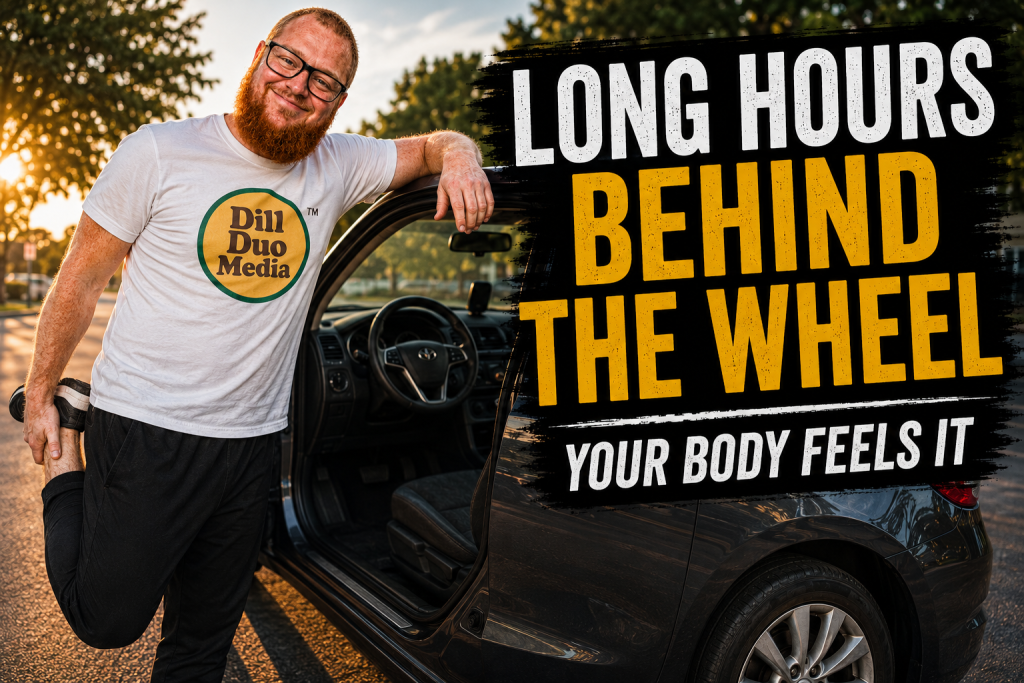
Gig Work Driving Stiffness Is Easy to Overlook
Delivery work can look sedentary from the outside.
There is plenty of sitting, but the day also includes repeated transitions: getting in and out of the vehicle, walking into buildings, carrying orders, climbing steps, and returning to the driver’s seat again.
Research involving professional drivers has found musculoskeletal discomfort across several parts of the body, with the lower back appearing especially frequently. Researchers have also examined prolonged sitting, awkward or static posture, repetitive movement, and whole-body vibration as potential contributing factors.
That does not mean every ache after a long shift was caused by driving.
Musculoskeletal discomfort can have many causes, and I would not reduce the issue to a simple rule like more hours behind the wheel automatically equals more pain.
The practical lesson is simpler.
If you spend a large part of your working life inside a vehicle, how you sit, how much you move, and how your body feels afterward are worth paying attention to.
The Tightness Can Sneak Up on You
The difficult part is that stiffness does not always announce itself while you are busy.
When work is coming in and you are thinking about mileage, traffic, pickup times, and the next decision, it is easy to stay focused on everything except how long you have been sitting.
Then you stand up after a long stretch and realize how tight everything feels.
I have found that stretching matters more to me than trying to squeeze a miniature workout into the middle of the workday.
That is an important distinction.
Something can be healthy in theory and still be a poor fit for the way you actually work.
Stretching Throughout the Day Does Not Have to Become a Workout
There is a tendency in productivity culture to stack everything together.
If you are waiting, exercise.
If you are driving, listen to something educational.
If you have five free minutes, optimize them.
I tried thinking about my workday that way, and it added stress instead of removing it.
When I am out working, my main job is to earn money and drive safely. I do not want to spend the entire shift wondering whether I completed enough exercises between pickups.
That does not mean I want to sit in the same position all day either.
I can stretch before I leave, take opportunities throughout the day to get out of the same seated position and loosen up, and stretch again when I get home.
Simply getting out of the vehicle, walking during normal pickups, changing position when appropriate, and stretching when I have a reasonable opportunity can add movement without turning the workday into a fitness program.
Research examining workplace sitting suggests that reducing prolonged sitting may help with some musculoskeletal discomfort, although results vary depending on the occupation, intervention, and part of the body being studied.
That’s one reason I prefer treating movement and stretching as practical habits instead of pretending there is one magic routine that prevents pain.
I take a similar approach to downtime in general. There are productive ways to use slow gig-work downtime, but I don’t believe every quiet minute has to become another task. Whatever I do during those periods still has to fit around the actual job and safe driving.
Stretching Can Be Simple
If sitting for long periods leaves you feeling tight, stretching does not need to become another complicated project.
A few gentle stretches in the morning, throughout the day when practical, and again after work are much more realistic for me than an elaborate routine.
I tend to think about the areas that feel tight from sitting: calves, hamstrings, hips, and the rest of the lower body.
The goal is not to force a stretch or chase pain.
It is simply to get some comfortable movement back after spending so much time in one position.
There is research suggesting workplace exercise and interruptions to prolonged sitting may help some people experiencing musculoskeletal discomfort, but the evidence is not strong enough to pretend there is one universal routine everybody should follow.
That fits the way I look at this anyway.
I am not trying to prescribe somebody else’s workout.
I am paying attention to what happens to my own body when I spend a lot of time sitting.
Don’t Forget About Water
Another part of my routine is simple: I drink plenty of water.
When I am going to spend a long day on the road, I would rather have water with me than realize halfway through the day that I have barely had anything to drink.
I have used the common rule of thumb of aiming for roughly half my body weight in ounces of water, and that has worked well for me personally.
But I would not present that as a universal formula everybody needs to follow.
Evidence-based hydration guidance does not prescribe half your body weight in ounces as a requirement. Water needs vary with things like activity, temperature, diet, body size, and individual health circumstances. Total water intake also includes water from food and other beverages.
So I treat my target as exactly what it is: a personal target that helps me remember to drink water consistently.
The larger lesson is much simpler.
If you are spending hour after hour on the road, don’t get so focused on working that you forget basic things like staying hydrated.
Your Vehicle Needs to Fit You Too
Movement is only part of the picture.
If you spend hours driving, the vehicle itself matters.
I have found that there is a real difference between spending a long workday in a vehicle where I have enough room to sit comfortably and spending those same hours feeling cramped.
That does not mean everybody needs a large vehicle.
It means you need enough room to position yourself comfortably without constantly reaching, twisting, squeezing your legs into an awkward position, or sitting in a way that already feels wrong before the workday is over.
Research involving professional drivers supports paying attention to this. Awkward posture has been associated with work-related musculoskeletal problems, and research has also identified uncomfortable seating as a factor worth considering.
Seat adjustment matters too.
If the seat is so far away that you are reaching for the pedals, so close that your legs feel cramped, or positioned in a way that leaves you unnecessarily twisted toward one side, repeating that position for hours can become uncomfortable.
I do not think the answer is finding one magical “perfect posture” and freezing yourself in it all day.
The practical point is much simpler:
If you are going to spend a significant part of your working life inside a vehicle, make sure the vehicle and seating position actually fit your body.
Pay Attention to What Your Body Is Telling You
There is a difference between ordinary stiffness after sitting and something that deserves professional medical attention.
Persistent or worsening pain, significant swelling, numbness, weakness, or other concerning symptoms are not things I would try to diagnose through a gig-work routine or an article on the internet.
That is especially important if you already have an injury or another physical issue.
General stretching, hydration, and movement ideas are not substitutes for individualized medical care.
For ordinary stiffness, though, I have learned not to ignore the obvious.
If spending hours in the vehicle consistently leaves me tight, I need some movement and stretching somewhere in my routine.
Build a Routine That Fits the Work
The biggest lesson for me is that taking care of yourself does not have to compete with earning money.
I can stretch before I leave.
I can loosen up throughout the day when it makes sense.
I can keep water with me.
I can make sure I am not unnecessarily cramped in the vehicle.
And I can stretch again when I get home.
During the workday, I can focus on the work itself while still noticing when I have been sitting for a long time or when my position is making me uncomfortable.
That approach is much more sustainable for me than trying to make every minute productive in three different ways.
Gig work already asks you to make decisions all day.
Your physical routine does not need to become another source of pressure.
Pay attention to the stiffness, move when it makes sense, drink your water, make sure your vehicle fits you, and build the rest of your routine around the life you actually live.