

By Christopher Dill
I learned about multiple income streams before I knew what multiple income streams were.
I was probably 13 or 14 years old.
And it happened because my mother apparently couldn’t trust me to stay home by myself.
To be fair, she had a reason.
I was throwing house parties.
Not house parties in the way an adult might picture them. I wasn’t charging admission at the door or running some elaborate teenage nightclub operation.
I was a kid.
But somehow, when my mom went to work, half the damn neighborhood could end up at our house.
People would come over. We’d hang out. We’d play music. We’d have a good time.
And sometimes people would show up who I didn’t even know.
That’s when you know your little get-together has gotten out of hand. When you’re 13 or 14 years old, standing in your mother’s house looking at somebody and thinking, Who the hell invited you?
Apparently word traveled.
Somehow, though, we’d usually get everything cleaned back up. Nothing was getting stolen. Nobody was destroying the house.
Usually.
There was one problem I remember very clearly.
One of my friends had shoes with black soles, and he had been dancing around on the kitchen floor.
When everybody left, there were black marks all over it.
I tried to clean them.
Those motherfuckers weren’t coming up.
That was a problem.
You can put everything back where it belongs.
You can clean up the evidence.
You can make sure nobody broke anything.
But when your mother comes home and the kitchen floor looks like somebody held a dance competition on it, there are only so many explanations available.
Eventually, my mom came up with a solution to the Christopher-is-home-alone problem.
You’re coming to work with me.
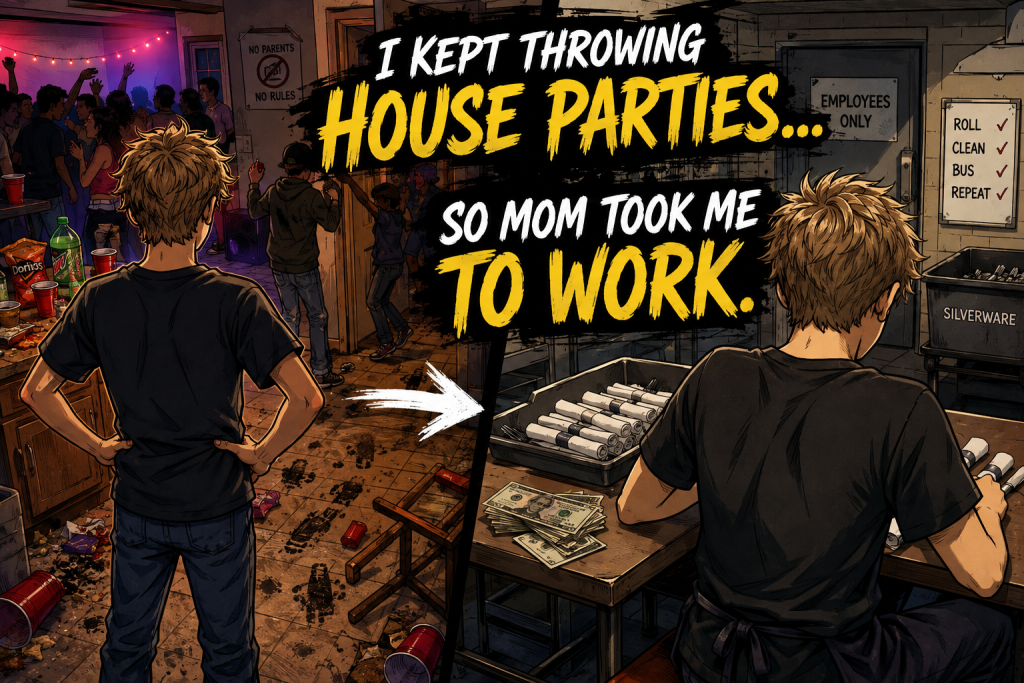
How Throwing House Parties Started My Career of Rolling Silverware
My mom worked at Ryan’s.
For anybody who doesn’t remember Ryan’s, it was one of those buffet-style restaurants where there was always something happening.
Servers moving around.
People eating.
Tables constantly needing to be cleaned.
Silverware constantly needing to be rolled.
And apparently there were plenty of things for a kid whose mother didn’t want him back at the house throwing another neighborhood party to do.
I was young enough that if somebody came around asking questions or wondering how old I was, I could stay toward the back and roll silverware.
But when my mom worked, I went with her.
And eventually, instead of just sitting around waiting for her shift to end, I started helping out.
I rolled silverware.
I bussed tables.
I cleaned tables.
I cleaned underneath them.
Whatever needed to be done.
The funny thing is that I actually started making pretty decent money for a kid.
Everybody Was Paying Me a Little Something
The manager would give me some money for doing things like rolling silverware.
Then the servers figured out that having me around could make their lives easier too.
At the end of the night, one might give me a little money for helping clean her section.
Another might give me something for cleaning underneath her tables.
Somebody else might give me a few dollars because I’d been bussing tables and helping keep things moving.
Nobody was handing me some giant paycheck.
It was little amounts.
A little from here.
A little from there.
And then another little bit from somewhere else.
But here’s the part I remember:
There were days when I would leave with more money than some of the servers had made.
I didn’t understand the economics of what was happening.
I certainly wasn’t sitting there at 13 or 14 years old thinking:
Christopher, what you’ve developed here is a diversified income strategy.
Hell no.
I was thinking:
This person gave me some money.
That person gave me some money.
And somehow I’ve got a pretty good amount of money in my pocket.
That’s all I needed to know.
I Wasn’t an Entrepreneurial Genius
Looking backward, it’s tempting to turn childhood stories into some grand explanation for everything that happened later.
I don’t want to do that.
I wasn’t standing in the back of Ryan’s developing a business plan.
I wasn’t studying entrepreneurship.
I wasn’t building spreadsheets.
I wasn’t thinking about revenue diversification.
I was a kid whose mother had figured out that one way to prevent me from turning our house into neighborhood party headquarters was to take my ass to work with her.
Then I figured out how to make some money while I was there.
That’s really what happened.
But adulthood gives you language for things you experienced long before you understood them.
And when I look backward now, I recognize the pattern.
One Source of Income Never Felt Like a Rule
There are people who grow up with a very straightforward idea of work.
You get a job.
The job pays you.
That’s your income.
There’s absolutely nothing wrong with that.
But somewhere along the way, I developed a different relationship with money.
Money could come from different places.
One person could pay you for doing one thing.
Somebody else could pay you for doing something else.
You could have a primary source of income and still make money somewhere else.
One opportunity didn’t necessarily have to replace another.
They could exist at the same time.
At Ryan’s, I didn’t have those words.
I just knew that the manager giving me a little money didn’t prevent a server from giving me a little money too.
And if several people needed something done?
Well…
Apparently several people could pay me.
Looking Back, the Pattern Is Pretty Obvious
I’ve spent a lot of my adult life with more than one thing going on.
I’ve worked regular jobs.
I’ve worked multiple jobs at the same time.
I’ve done independent contractor work.
I’ve worked in the gig economy.
I’ve resold things.
I’ve written and published books.
I’ve created educational materials.
I’ve built Dill Duo Media.
Different periods of my life have involved different combinations, and not everything has always produced the same amount of money.
But the basic idea never seemed strange to me.
Why should income have to come from one place?
Apparently, somewhere deep in my brain, I’d already learned otherwise.
Not from a finance class.
Not from a business seminar.
Not from somebody on the internet telling me I needed seven streams of passive income before breakfast.
I learned it because my mother couldn’t trust me at home.
The Punishment Kind of Backfired
That’s probably my favorite part of the story.
My mom’s solution made perfect sense.
If Christopher can’t stay home without inviting everybody over, Christopher doesn’t get to stay home.
He’s coming to work.
Problem solved.
And technically, it worked.
I couldn’t throw a house party if I was sitting at Ryan’s rolling silverware.
But instead of simply being miserable about having to go to work with my mother, I ended up finding something to do.
Then somebody paid me for it.
Then somebody else paid me.
Then somebody else did too.
Suddenly being dragged to work wasn’t quite as bad.
I had money in my pocket.
And for a kid that age, having your own money felt pretty damn good.
I Didn’t Know I Was Learning Anything
That’s one of the strange things about childhood.
Some lessons don’t announce themselves as lessons.
Nobody sits you down and says:
Pay attention. This experience will influence how you think about work years from now.
You’re just living.
I was living.
I was trying to have fun when my mom wasn’t home.
She was trying to keep me from having too much fun when she wasn’t home.
Ryan’s needed silverware rolled and tables cleaned.
The servers wanted somebody to make their night a little easier.
And I wanted money.
Everybody’s interests happened to line up.
Years later, I can look backward and see something I couldn’t see then.
That wasn’t the beginning of some perfectly planned entrepreneurial journey.
Life isn’t that neat.
But it may have been one of the first times I learned that a little money coming from several directions can turn into something meaningful when you put it together.
I didn’t call it multiple income streams.
I didn’t call it entrepreneurship.
I didn’t call it anything.
I just counted the money.
And apparently, that lesson stuck.
The Lesson Still Applies
One thing I’ve learned repeatedly since then is that it’s good to have several sources of income.
Not because every source is going to make you rich.
Not because every side hustle lasts forever.
Actually, it’s almost the opposite.
Things change.
Jobs change.
Businesses change.
Platforms change.
Markets change.
Side incomes evolve.
Some grow into something bigger.
Some work for a few years and slow down.
Some disappear completely.
Something you can make good money doing today might not even exist five or ten years from now.
That’s why I’ve never liked the idea of having everything dependent on one source.
If one income slows down, another might still be working.
If an opportunity disappears, you’ve already got other things moving.
And even when things are going well, I think it’s important to keep your eyes open.
What’s next?
Not because you have to chase every opportunity that comes along.
You don’t.
But you should pay attention.
I’ve made money in different ways at different points in my life, and those ways have changed as my life has changed.
Some became important parts of my income.
Some stayed on the side.
Some eventually weren’t worth doing anymore.
And new ones came along that I couldn’t have predicted years earlier.
That’s the part 13- or 14-year-old me couldn’t have understood while rolling silverware and bussing tables at Ryan’s.
I wasn’t learning how to make money one particular way.
I was learning that money didn’t necessarily have to come from one place.
All these years later, I still believe that.
Have several things working.
Understand that some of them will change.
Don’t assume today’s opportunity will always be tomorrow’s opportunity.
And keep looking at what’s next.
Apparently, I learned all of that because my mother couldn’t trust me to stay home without throwing a house party.
There are worse ways to learn a lesson.