
By Christopher Dill
When I first started this journey, I genuinely didn’t know if anybody was going to buy my books.
I don’t mean I wondered whether I’d sell a thousand copies or whether one of my books would become a bestseller. I mean I didn’t know if I would sell any.
Zero was a very real possibility.
I’m part of a lot of author groups, and if you spend enough time in those spaces, you’ll see the same frustration come up over and over again. Someone spent months or years writing a book. They edited it. Formatted it. Designed a cover. Finally worked up the courage to publish it.
Then they waited.
Nothing.
Maybe they sold a copy to a friend or family member. Maybe they didn’t even get that.
You’ll see authors asking what they’re doing wrong. You’ll see people wondering whether they should change their cover, rewrite their description, lower their price, spend money on advertising, change genres, or just give up altogether.
I saw all of that before and during my own publishing journey.
So I never went into this assuming people were going to buy my books simply because I wrote them.
Then somebody bought one.
Then another one sold.
Then a couple more.
Then there were stretches where nothing happened.
Then another sale would show up.
Then I had a bigger surge.
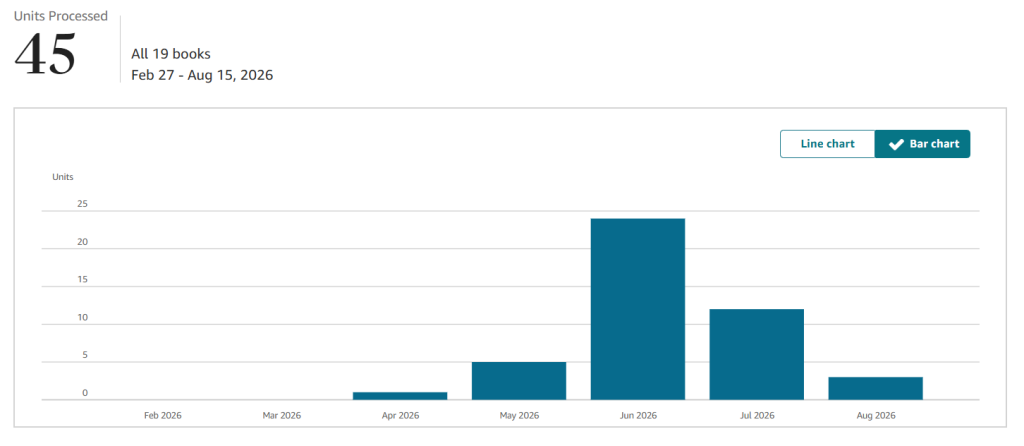
And somewhere along the way, I went from wondering whether anybody would ever buy one of my books to opening my Amazon dashboard and seeing something I still think is pretty damn cool:
45 books sold.
That’s just Amazon.
My books have also reached readers through other platforms, and across all of them, my work has now found its way to readers in the United States, Canada, Germany, Hong Kong, Australia, and France.
When I actually stop and think about that, it’s wild.
Forty-Five Isn’t a Bestseller. That’s Not the Point.
I want to be clear about something.
I’m not writing this because I think 45 books makes me some massive bestselling author.
It doesn’t.
There are authors who sell 45 books before they finish their morning coffee.
There are authors who sell thousands of copies every month. There are names everybody recognizes whose careers operate on an entirely different scale.
I’m not comparing myself to them.
Actually, that’s part of the point of this article.
Why would I?
Their journey isn’t my journey.
Their twentieth year isn’t my first year. Their audience isn’t my audience. Their book isn’t my book. Their circumstances aren’t my circumstances.
Forty-five matters to me because I remember when the number was zero.
There was a point when I didn’t know whether one complete stranger would ever look at a book with Christopher Dill on the cover and decide, Yeah, I want to read that.
Now that’s happened over and over again.
That’s worth appreciating.
And what makes it even more interesting to me is that people aren’t all buying the same book.
Different Readers Keep Finding Different Parts of Me
One of the things I’ve learned about myself as a writer is that I don’t particularly want to stay in one little box.
My interests don’t work that way.
Neither does my mind.
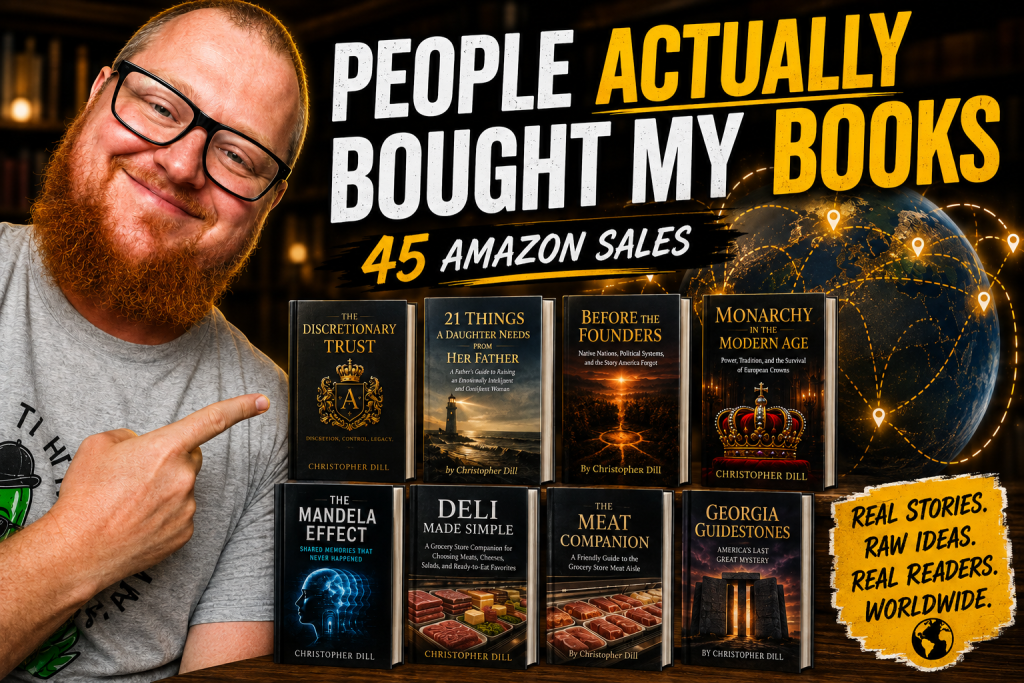
I can become interested in history and political institutions and write something like Monarchy in the Modern Age: Power, Tradition, and the Survival of European Crowns.
Then I can turn around and explore something completely different in The Mandela Effect: Shared Memories That Never Happened.
I can write something far more personal and grounded in fatherhood with 21 Things a Daughter Needs From Her Father: Raising an Emotionally Intelligent and Confident Woman.
And then I can go create fiction.
When somebody bought The Discretionary Trust, that one hit me a little differently.
That’s one of my fiction books, and it’s a book I’m really proud of.
With nonfiction, somebody can be interested in the subject before they ever know who you are. They may want to learn about a historical institution, an unexplained phenomenon, parenting, or whatever subject brought them to the book.
Fiction asks something different of the reader.
You’re asking somebody to step into something that came out of your imagination.
The characters weren’t there until you created them. The situations weren’t there. The story wasn’t there.
Then somebody bought The Discretionary Trust.
I remember the feeling being basically:
Yes. Somebody bought it.
That’s the kind of thing a sales dashboard can’t really communicate.
It gives you a number.
It doesn’t tell you what that number feels like when you created the thing being counted.
And that’s one reason I don’t regret writing across different subjects.
Different people keep finding different pieces of the catalog.
I’m okay with that.
Actually, I love it.
An Ebook Sale Is Cool. A Paperback Feels Different.
Every ebook sale matters to me.
Somebody found something I wrote, decided it was worth paying for, downloaded it, and now my words are sitting on their Kindle, phone, tablet, computer, or whatever they prefer to read on.
That’s cool.
But I’ve discovered that paperback sales hit me on another level.
A paperback is physical.
I can sit here in Georgia and look at an order that came from another state or another country and realize that somewhere out there is an actual physical object with my name printed on it.
Something that started entirely inside my head now exists in somebody else’s home.
Think about how strange that really is.
A thought happens.
Maybe it starts as nothing more than a question.
Maybe it’s something I’ve been thinking about for years.
Maybe it’s something that happened in my life.
Maybe it’s something I researched.
Maybe it’s something I noticed that made me think, There’s more to this.
Maybe it’s an entirely fictional idea that didn’t exist anywhere until it popped into my head.
Then I start writing.
One thought becomes another.
One page becomes ten.
Ten pages become fifty.
Eventually, that collection of thoughts becomes a finished book.
Then that file becomes an actual printed object.
And then somebody I’ve never met buys it.
Now my thoughts, my ideas, my interests, my research, my stories and my voice are physically sitting on somebody else’s bookshelf.
That is fucking cool.
I don’t know exactly where those books are.
I don’t know what room they’re in.
I don’t know what’s sitting beside them on the shelf.
I don’t know whether the owner has already read the whole thing, is halfway through it, or bought it and put it aside for later.
But I know they’re out there.
Some of them are thousands of miles away.
Some crossed international borders.
There are people in countries I’ve never met who have read words that once existed only in my head.
I don’t think I’ll ever completely get over how cool that is.
One Day, I Want to Find One in a Thrift Store
Apparently, authors have very different feelings about used copies of their books.
I’ve seen authors say that it bothers them to see somebody reselling their book.
I understand some of the reasoning. If somebody buys a used copy, the author isn’t receiving another royalty from that particular transaction.
But I don’t think that’s how I’m going to feel about it.
I actually look forward to it.
One day, I want to walk into a thrift store, start looking through the books, and suddenly see my own damn name sitting there.
I already know I’m going to stop.
I’ll probably pick it up.
I’ll probably stand there staring at it longer than any normal person should.
And I’ll probably think it’s one of the coolest things I’ve ever seen.
Because that book had a life before it reached that thrift-store shelf.
Somebody bought it.
They took it home.
Maybe they read it once.
Maybe they read it twice.
Maybe they loved it.
Maybe they hated it.
Maybe it sat on their bookshelf for five years.
Maybe they moved and decided they had too many books.
Maybe somebody inherited it.
Who knows?
But eventually that copy moved on.
And now somebody else can find it.
I spend plenty of time around resale myself, so maybe that’s part of why I look at it differently.
I don’t automatically see a secondhand item as something nobody wanted.
Sometimes it simply finished its time with one person and is waiting for the next.
If somebody finds one of my books for $2.99 in a thrift store years from now, picks it up because the cover catches their attention, reads the back and thinks, This sounds interesting, that’s another person discovering something I created.
Maybe they like it enough to look up my other books.
Maybe they don’t.
Either way, the book kept moving.
There’s something beautiful about that to me.
Yes, I Am Absolutely the Author Who Refreshes My Dashboard to Check My Amazon Book Sales
I should admit something.
I check my sales.
Probably more often than necessary.
I’ll be doing something completely unrelated, have a minute, open the dashboard and refresh it.
Nothing new.
Okay.
Close it.
Go back to whatever I was doing.
Later?
Refresh.
Still nothing.
All right.
Then I’ll check again at some point and—
Oh shit. Another book sold.
And yes, I still get excited.
I’m absolutely that person.
Maybe one day enough books will be selling that individual orders won’t stand out anymore.
I’d love to have that problem.
Imagine opening the dashboard and seeing a thousand sales instead of wondering whether another one came through today.
That would be amazing.
But I’m not there yet.
And maybe there’s something good about this stage too.
Right now, I still notice every one.
Every sale represents an actual decision somebody made.
Nobody had to buy my book.
There are millions of books available.
There are famous authors with enormous advertising budgets. There are classics. There are new releases every day. There are more books available than any person could read in a hundred lifetimes.
And somebody chose mine.
That’s worth being excited about.
I Spent Too Much of My Life Trusting Myself to Remember My Ideas
There’s another part of this journey that has become even more important to me than sales.
For most of my life, I’ve had ideas constantly.
My mind goes all over the place.
One thought connects to another thought, which connects to something else, which reminds me of something from five years ago, which creates another idea.
And for a long time, I did what I think a lot of people do.
I’d have an idea and think:
I’ll remember that.
No, I wouldn’t.
I’d remember some of them.
I’d forget a lot of them.
And sometimes I’d know I’d had a great idea but couldn’t remember what the hell the idea actually was.
That’s frustrating.
Because once it’s gone, it’s gone.
At some point, I stopped expecting my brain to be the permanent storage system for everything I thought about.
I started putting things on the computer.
Notes.
Fragments.
Titles.
Ideas.
A few paragraphs.
Research.
Questions.
Half-developed concepts.
Things that might eventually become books.
Things that might become articles.
Things that might become something I haven’t even thought of yet.
And I kept doing it.
Notes and notes and notes and notes.
I honestly wouldn’t be surprised if I have 10,000 or more files on my computer at this point.
I’m not saying there are 10,000 finished books sitting there.
There aren’t.
I’m saying there are thousands upon thousands of pieces of thought.
And that has been incredibly freeing.
Writing Things Down Gave My Brain Permission to Let Them Go
There’s a relief that comes with capturing an idea.
Once I’ve written something down and saved it, I don’t have to keep repeating it in my head because I’m afraid I’ll lose it.
It’s there.
I can let it go.
I can think about something else.
Maybe I come back tomorrow.
Maybe six months from now.
Maybe three years from now.
The idea doesn’t care.
It’s waiting.
And sometimes something really interesting happens when you come back to an old thought.
You’ve changed.
You’ve learned more.
You’ve experienced more.
Now that old idea connects with a newer one.
Suddenly the three paragraphs you wrote two years ago make sense beside the notes you made last week.
That’s how something bigger can start forming.
An idea you never capture has to survive your memory. An idea you write down gets the chance to survive you forgetting it.
That has probably been one of the biggest changes in how I create.
Not every idea needs to become a book.
That’s important too.
Some ideas will become articles.
Some will become sections of another project.
Some will merge with completely different ideas.
Some may sit untouched forever.
That’s okay.
The first job isn’t deciding whether an idea deserves to become a product.
The first job is simply:
Don’t lose it.
Put Your Ideas Somewhere
If you’ve ever thought about writing a book, that’s probably the simplest advice I can give you.
Stop waiting until you have “a book.”
Start with an idea.
Write it down.
Then the next time you think of something related to it, add that.
Then another.
Maybe you start seeing connections.
Maybe one thought creates five more.
Build on them.
Research the things you don’t know.
Question the things you think you know.
Move pieces around.
Combine ideas that belong together.
Eventually you may look at what you’ve accumulated and realize:
There’s a book here.
That’s how ideas grow.
They don’t always arrive as a perfectly organized 60,000-word manuscript.
Sometimes they’re scattered pieces that slowly start finding each other.
But they can’t find each other if you keep letting them disappear.
Write Your Book Your Way
This is where I think a lot of aspiring authors get themselves stuck.
They look at the biggest names in publishing.
They look at the people selling hundreds of thousands or millions of books.
Then they start trying to measure themselves against them.
They try to write like them.
Market like them.
Structure everything like them.
And somewhere along the way, they can forget why they wanted to write in the first place.
I’m not saying you shouldn’t learn from successful writers.
Of course you should.
I’m not saying editing doesn’t matter.
It does.
I’m not saying presentation, covers, descriptions, formatting and marketing don’t matter.
They absolutely do.
I’m saying your book still needs to be yours.
Write the book you want to write.
Write it the way you want to write it.
Put your perspective into it.
Put your voice into it.
If you’re interested in something, explore it.
If you have something you want to say, say it.
If you’ve got a story living in your head, give it somewhere else to live.
Then finish it.
Put it out there.
And move on to the next one.
And the next.
And the next.
That idea became important enough to me that I eventually wrote more about why I believe you should write your book your way—and then write the next one, instead of making one title responsible for proving whether you belong as a writer.
Your first book may not be the one that takes off.
Neither may your second.
Or your third.
Maybe your tenth book is the one somebody discovers.
Maybe they love it and work backward through everything else you’ve written.
Maybe a book sits there for two years before the right reader finds it.
Maybe something you were convinced would sell doesn’t.
Maybe the weird little project you almost didn’t publish becomes the thing people keep buying.
You don’t know.
Neither do I.
That’s part of it.
But if you genuinely love writing, the sales can’t be the only reason you do it.
What If Nobody Buys It?
That’s the question, isn’t it?
What if you put all that work into a book and nobody buys it?
Obviously, I’d rather somebody buy it.
I’m not going to sit here and pretend sales don’t matter.
I publish books because I want people to read them. I’m building a business. I want that business to grow. I would love to sell far more than 45 copies.
But there’s another question worth asking:
Are you proud of what you made?
Because if you are, the book already did something.
You took something that existed only in your mind and turned it into something real.
You finished it.
That’s something a lot of people who say they want to write a book never actually do.
You don’t control what happens after that.
You can market it.
You can improve how it’s presented.
You can tell people about it.
But you cannot force the world to care.
You can also make thoughtful business decisions around the book without letting fear take over. That includes things like how you price your books as an indie author without racing to the bottom. Lowering the price simply because a book hasn’t sold yet isn’t automatically the answer.
And I don’t think you should let that stop you from creating.
If I like what I made, I put it out there.
Then I start thinking about what I want to make next.
That’s increasingly how I look at all of this.
Write for the love of writing. Create for the love of getting the ideas out.
If people buy it, that’s amazing.
If they don’t, you still created something you wanted to exist.
And then you get another idea.
Dill Duo Media Started the Same Way
The funny thing is that this philosophy didn’t stop with books.
Dill Duo Media started as an idea.
Then the idea grew.
Then another piece connected to it.
I’ve always done a lot of different things. I have a lot of different interests. For a while, it was easy to look at all of them as separate.
Books over here.
Another project over there.
Resale somewhere else.
Educational materials somewhere else.
Articles.
Creative ideas.
Business ideas.
Different things I enjoy doing, all living in their own little worlds.
Eventually I started asking myself:
Why?
Why do all of these things have to be disconnected?
Why not build an umbrella big enough for the things I already enjoy doing?
That’s part of what Dill Duo Media has become.
One idea connected to another.
Then another.
Then another.
The books became part of it.
The articles became part of it.
The educational resources became part of it.
The website gave those things a home where they could start connecting to each other.
And I’m still building it.
I don’t know exactly what Dill Duo Media will look like five years from now.
That’s okay.
I didn’t need to know the ending before I started.
I needed the first idea.
Then I needed to save the next one.
Then connect them.
That’s the same process I’ve used with writing.
Capture it. Build on it. Connect it. Make something.
Then keep going.
The Books Are Out There Now
Sometimes I think about all of this and come back to that bookshelf.
Somewhere there’s a book I wrote sitting in somebody’s house.
Actually, there are a bunch of them now.
Different books.
Different readers.
Different places.
Some are digital files.
Some are physical books.
Some are in the United States.
Others have reached Canada, Germany, Hong Kong, Australia and France.
I don’t know most of the people reading them.
They don’t know me.
But for however long they spend with one of those books, they’re spending time with something that came from my thoughts.
That’s a strange connection between two people who may never meet.
And it only exists because I eventually stopped keeping all of those ideas inside my head.
I wrote them down.
If You’re Curious About What I’ve Written
I’ve never tried to make every book fit the same mold, and I don’t plan to start now.
My catalog reflects the things I’ve been interested in, the things I’ve researched, the experiences I’ve had, the questions I’ve asked and the stories I’ve wanted to tell.
If you’d like to see what’s come out of all of that, you can browse my books on the Dill Duo Media Books page.
Maybe one of them will be your kind of book.
Maybe it won’t.
That’s okay too.
There will probably be another one.
I have a lot of files.
Here’s to the Next 45
When I started publishing, I didn’t know if anybody would buy my books.
Now I know the answer.
Somebody will.
Not everybody.
Not millions of people.
Maybe not even thousands.
But somebody already has.
Forty-five times on Amazon, and more through other platforms.
And every one of those sales represents something that would never have happened if the idea had stayed in my head.
That’s the part I want other people with ideas to understand.
You don’t have to know whether the world is going to love what you create before you create it.
You don’t need permission.
You don’t need to become the next version of somebody who’s already famous.
And you don’t need your first attempt to become the thing that defines you.
Put your ideas somewhere.
Build on them.
Connect them.
Write your book.
Write it your way.
Finish it.
Put it into the world.
Be proud that you made something that didn’t exist before you made it.
Then move on and make something else.
Maybe someday you’ll refresh a dashboard and discover somebody on the other side of the world just bought it.
Maybe someday you’ll walk through a thrift store and find your own name staring back at you from a bookshelf.
I hope I do.
Until then, I’ll keep writing.
I’ll keep building.
I’ll keep putting ideas somewhere other than inside my head.
And yes, I’ll probably keep refreshing that damn sales dashboard too.
Here’s to the next 45.