
By Christopher Dill
Writing a book takes a lot of work.
You have the original idea.
Then comes the research, writing, rewriting, editing, formatting, cover design, metadata, uploading, pricing, and everything else that happens before somebody can finally buy it.
After all that work, it’s easy to fall into a simple routine:
Publish the book.
Put it on a retailer.
Post about it a few times.
Move on to the next one.
I’ve started looking at my books differently.
Once I’ve created the book, I don’t just have a paperback or an ebook.
I have intellectual property.
The manuscript is the hard part. That’s the original creative asset.
Once that exists, I can start asking a different question:
How many legitimate products, formats, and pieces of content can grow from this one thing I already created?
That doesn’t mean squeezing every possible dollar out of every paragraph.
It doesn’t mean turning one book into 47 useless products just so I can say I did it.
It means recognizing that one book can become multiple products when those products naturally extend what I’ve already created.
A finished book can have a much longer life than a single retailer listing.
A Book Isn’t Just a Book Anymore
For most of publishing history, the product was obvious.
You wrote a book.
Somebody printed it.
Somebody bought it.
Today, the same intellectual property can potentially exist as an ebook, paperback, hardcover, audiobook, digital bundle, read-along product, website feature, educational or supplemental material, social media content, video content, articles built around the subject, behind-the-book content, promotional excerpts, and discussions.
Not every book should become all of those things.
That’s important.
But every time I finish a book now, I want to ask:
What else does this particular book naturally want to become?
That’s a very different question from simply asking where I’m going to list it for sale.
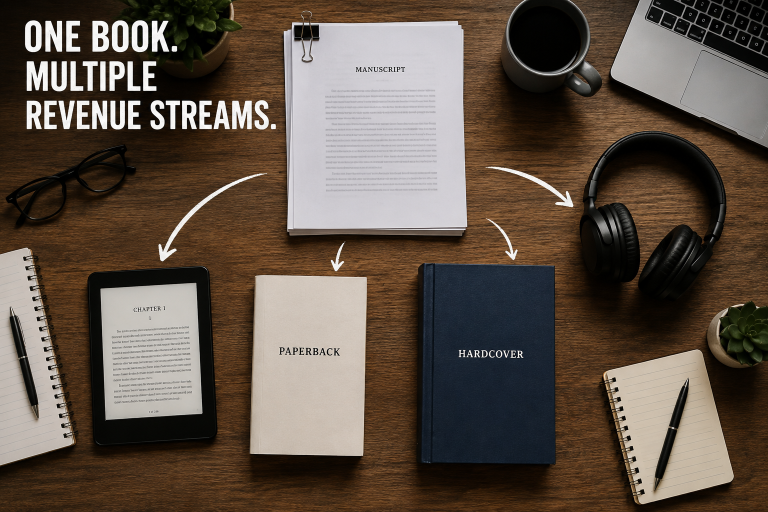
There’s also an important distinction between what I’m talking about here and simply publishing a book in several formats. In One Book, Multiple Revenue Streams: Why I Publish in Every Format I Can, I look specifically at giving the same book more opportunities through ebook, paperback, hardcover, audiobook, and wider distribution.
This goes beyond that.
This is about asking whether the intellectual property itself can support something else of genuine value.
Start With the Core Intellectual Property
The book itself comes first.
I don’t believe in creating a bunch of products around something that doesn’t have substance at the center.
The manuscript is the asset.
Everything else grows from that.
If I’ve written a nonfiction book, I’ve already invested time into the ideas, structure, research, explanations, examples, and overall argument.
If I’ve written fiction, I’ve already created the characters, world, plot, dialogue, conflicts, and story.
If I’ve written a children’s book, I’ve already developed the story, language, illustrations, message, and reading experience.
That’s valuable work.
So when the manuscript is complete, I’m not necessarily starting over every time I create something related to it.
I’m adapting something that already exists.
That distinction matters.
I’m not looking for ways to duplicate the exact same product and pretend it’s new.
I’m looking at the underlying asset and asking where else it can legitimately create value.
The Obvious First Step Is Ebook and Print
The simplest example is publishing the same title in multiple traditional formats.
A book might have an ebook edition, paperback edition, and hardcover edition.
They’re all the same underlying intellectual property, but they’re not necessarily serving the same customer.
One reader wants something inexpensive that can be downloaded instantly.
Another wants a physical paperback.
Someone else prefers hardcovers and is willing to pay more for them.
The manuscript didn’t need to be rewritten three times.
The product was adapted for three different ways people consume books.
That’s the basic principle behind everything else.
But traditional formats are only the beginning.
Then Audio Changes the Product Again
Audiobooks really drove this idea home for me.
When I started going through my catalog and looking at actual audiobook runtimes, I realized how different a book can feel when it’s translated from pages into time.
One book might become a 45-minute focused listen.
Another becomes three hours.
One of my novels, The Discretionary Trust, runs more than nine and a half hours in audio.
Then I had the opposite experience with a children’s book.
The narration was only about 94 seconds.
At first, that sounds almost absurdly short for an audiobook.
But then I stopped looking at it only as:
a 94-second audiobook.
I started looking at what else already existed around it.
The story.
The illustrations.
The digital book.
The narration.
Those pieces could potentially work together as a read-along experience.
The short audio wasn’t necessarily a bad product.
It may simply have been a piece of a different product.
That shift in thinking is important.
Sometimes the question isn’t:
How do I sell this individual file?
Sometimes it’s:
What experience can these assets create together?
A Children’s Book Can Become a Read-Along
Children’s books are probably one of the clearest examples of this.
Suppose you already have the illustrated book.
Then you create narration.
Now you have the visual story and the spoken story.
Put those together correctly and you can potentially create a read-along version where children hear the story while following the illustrations.
That could become a video.
It could become part of a digital bundle.
It could become supplemental material.
It could potentially support activities or discussion questions if those additions genuinely fit the story.
The key word there is genuinely.
I’m not interested in attaching five random worksheets to a children’s story so I can advertise a “MEGA BUNDLE.”
The additional material should improve the experience.
If it doesn’t, it doesn’t belong there.
Think in Terms of the Experience, Not the File
This is one of the biggest changes in how I think about digital products.
A PDF is a file.
An EPUB is a file.
An MP3 is a file.
A video is a file.
A customer isn’t really buying the existence of a file.
They’re buying what the file allows them to do.
Read the story.
Listen to the story.
Learn something.
Solve a problem.
Teach a lesson.
Entertain a child.
Understand a subject.
That means sometimes several relatively simple assets become more useful when they’re put together intentionally.
A children’s book, narration, and read-along could make sense together.
A nonfiction book and useful reference material might make sense together.
A practical guide and a checklist might make sense together.
A collection of related materials might eventually make sense as a bundle.
The goal isn’t:
Make everything sellable.
The goal is:
Use each piece where it creates the most value.
That’s a healthier way to think about expanding intellectual property.
Your Book Can Also Become Website Content
This is an area I’ve been thinking about more as I’ve built out Dill Duo Media.
A book contains ideas.
Those ideas can create conversations that don’t require giving away the entire book.
If I’ve written a book about the Mandela Effect, for example, the website doesn’t have to contain an article saying:
Buy my Mandela Effect book.
That’s advertising.
Instead, I can write useful articles about memory, cultural repetition, nostalgia, false memories, internet culture, or why groups of people become convinced they remember the same thing.
The book can be mentioned naturally because it’s relevant.
But the article should still have value if the reader never buys anything.
That’s the difference between building content around a book and simply turning every webpage into an advertisement.
It also gives somebody another way to discover the work.
They may never have searched for my book.
They might search for a question.
They find an article.
The article introduces them to Dill Duo Media.
From there, they might Explore Our Books and discover the book that started the entire chain.
That’s much more useful to me than treating the book listing as the only doorway into the subject.
The Publishing Process Itself Can Become Content
This was something I didn’t fully appreciate until I started documenting more of what I was actually doing.
A book doesn’t only create content because of its subject.
The process of publishing it can create content too.
While working with audiobooks, I learned about audiobook runtimes, audio mastering, RMS levels, MP3 bitrate, retail samples, audiobook covers, metadata, distribution policies, human versus digital narration, and platform differences.
Those experiences created entirely new article ideas.
None of those articles require me to give away the contents of the book.
They’re about what happened while I was publishing it.
That’s an important distinction for authors trying to build an online presence.
You don’t have to constantly invent unrelated things to talk about.
Sometimes you can simply document what you’re already learning.
And the more books you publish, the more valuable it becomes to preserve that knowledge instead of figuring everything out again. That’s part of what I get into in What Publishing More Books Taught Me About Building Systems Instead of Starting Over.
One Publishing Problem Can Become an Evergreen Article
This is one of my favorite parts of the process.
Problems are annoying when you’re dealing with them.
Later, they can become useful.
I spent time preparing an auto-narrated audiobook for ACX.
I corrected audio levels.
I fixed bitrate settings.
I prepared the retail sample.
I got the files through technical analysis.
Then the audiobook was rejected because of the platform’s policy regarding that type of narration.
Frustrating?
Absolutely.
But afterward, that experience became something useful I could write about for other independent authors.
Instead of the time disappearing into a failed experiment, part of what I learned became an article.
That’s another way intellectual property and publishing work can compound over time.
The original book created the reason I was dealing with the audiobook.
The audiobook created the problem.
Solving the problem created knowledge.
The knowledge created another piece of useful content.
Not everything has to end exactly where it started.
Books Can Feed Social Media Without Every Post Being an Advertisement
There’s also a major difference between:
promoting a book
and
creating content from the world around a book.
If every social post says:
My book is available now. Buy it here.
people are going to tune out.
But books naturally contain questions, ideas, quotes, debates, stories, facts, themes, characters, and observations.
Those can become short videos, questions, memes, reels, behind-the-scenes posts, interesting facts, reader discussions, short excerpts, or author stories.
A book about the Mandela Effect can produce posts asking people what they remember.
A history book can create discussions around surprising historical events.
A novel can generate character quotes or questions about the decisions characters make.
A parenting book can lead to conversations between parents.
The book is still being promoted.
It just isn’t screaming BUY MY BOOK every time someone sees it.
That’s a much more natural way to build an audience around the ideas.
One Book Can Feed Another Product
Sometimes a book reveals something readers need that isn’t another book.
A nonfiction book might naturally lead to a checklist, worksheet, reference guide, companion resource, printable, workbook, or bundle.
A children’s book might lead to a read-along, coloring pages, activities, discussion questions, or educational materials.
A fiction series might eventually support character guides, maps, bonus stories, collections, or special editions.
Again, I wouldn’t manufacture these things just because they can exist.
The product should solve a problem or improve the experience.
If it doesn’t, leave it alone.
That’s especially important because once you start thinking in terms of products, it’s very easy to start confusing more stuff with more value.
They’re not the same thing.
Bundles Can Change the Perceived Value
Sometimes individual pieces don’t look particularly impressive by themselves.
Put the right pieces together and the value changes.
Think again about a children’s book.
A PDF by itself is one thing.
An EPUB is another.
A 94-second narration is another.
A read-along video is another.
Individually, some of those pieces might feel too small to become products.
Together, they can create a complete digital reading experience.
That’s why I increasingly think in terms of product architecture rather than simply files.
The customer doesn’t care how many files I created.
The customer cares about what those files allow them to do.
That’s the same principle I use elsewhere in Dill Duo Media.
A bundle should exist because the pieces make more sense together—not because putting five filenames in a ZIP suddenly makes something valuable.
Different Products Reach Different People
This may be the simplest business reason for expanding a book.
People consume information differently.
Some people love physical books.
Some read almost everything on their phone.
Some listen while driving.
Some watch videos.
Parents may want something they can read with their children.
Teachers may want something printable.
Someone researching a topic might discover an article through Google before they ever know I wrote a book.
The underlying idea can reach all of them.
The format changes.
The product may change.
The entry point may change.
But the intellectual property at the center can still be connected.
But Don’t Turn This Into Busywork
There’s a trap here.
Once you start seeing all the things a book could become, it’s easy to create another problem:
You spend all your time repackaging old work and never create anything new.
I don’t want that either.
There has to be a reason for the additional product.
Does it reach a different audience?
Does it make the book more accessible?
Does it add genuine value?
Does it create another legitimate sales channel?
Does it help people discover the original book?
Does it fit naturally with the subject?
If I can’t answer one of those questions, I probably don’t need the new product.
More files aren’t automatically more business.
The same problem exists with platforms. Once you start seeing opportunities everywhere, it’s easy to convince yourself that you need to pursue all of them. That’s why You Don’t Have to Be Everywhere to Build a Business matters just as much as finding new ways to use an existing asset.
Expansion still has a cost.
Time is one of those costs.
Not Every Book Needs Every Format or Product
I think this is worth repeating because publishing advice often turns into formulas.
“You need an audiobook.”
“You need a hardcover.”
“You need a workbook.”
“You need a course.”
“You need merchandise.”
No.
Maybe you do.
Maybe you don’t.
A short practical guide may not need a $25 hardcover.
A children’s picture book may benefit enormously from a read-along.
A long novel might make an excellent audiobook.
A highly visual reference book may work terribly in audio.
A nonfiction book with exercises may naturally support a workbook.
Let the content tell you what makes sense.
And let the economics tell you something too.
A product that technically can exist isn’t automatically worth the time or money required to create and maintain it.
Think in Terms of Assets, Not Uploads
This is probably the biggest change in the way I look at publishing.
An upload feels temporary.
You upload the EPUB.
You upload the paperback interior.
You upload the cover.
Done.
An asset feels different.
An asset is something I own that can continue creating value.
The manuscript is an asset.
The cover is an asset.
The audiobook master is an asset.
The illustrations are assets.
The research can be an asset.
The publishing experience itself can become knowledge that creates additional content.
Once I started looking at books this way, my catalog stopped feeling like a collection of individual retailer listings.
It started feeling like a library of intellectual property.
And once the assets begin multiplying, organization becomes increasingly important. That’s another reason What Publishing More Books Taught Me About Building Systems Instead of Starting Over became its own conversation instead of a footnote to publishing.
If I don’t know what I’ve already created or where I’ve stored it, I can’t efficiently use it again.
That’s Where the Compounding Starts
The first book is difficult because everything has to be created.
But once the intellectual property exists, new possibilities can build from it.
One manuscript becomes several traditional book formats.
The book becomes audio.
The subject produces articles.
The articles create search traffic.
The ideas become social content.
The social content introduces new people to the book.
A specialized version becomes a bundle.
A children’s story becomes a read-along.
One format points toward another.
That doesn’t mean everything succeeds.
It means the original creative work gets more opportunities to succeed.
That’s also why I don’t see this as a replacement for writing new books.
The new books create new intellectual property.
The existing books create assets I can continue developing when it makes sense.
Those two things can work together.
I’m Still Learning What My Own Books Can Become
I don’t pretend that I’ve figured out the perfect publishing system.
I’m actively building it.
Some experiments work.
Some don’t.
Some ideas get parked for later.
Some formats make sense immediately.
Others only become obvious after I see the book in a completely different form.
That’s exactly what happened when a 94-second children’s audiobook made me stop thinking about audiobook length and start thinking about the entire reading experience.
And it’s what happened when preparing longer audiobooks showed me that my existing books could become substantial audio products without writing another manuscript.
Every time I put one of my books into another format or try another legitimate extension, I learn something else about what I’ve actually created.
That doesn’t mean I need to endlessly revise or rebuild the original book.
Sometimes the book is finished exactly as it is.
The question is what can grow around it.
Write the Book Once. Keep Asking What It Can Become.
I’m still going to write new books.
That’s the foundation of what I do.
And I still believe in Write Your Book Your Way—and Then Write the Next One. One book doesn’t have to become the project you endlessly tinker with because you’re afraid to move forward.
But moving forward and continuing to use intellectual property you’ve already created aren’t opposites.
I can write the next book while recognizing that the previous one may still have more work it can do.
Once the book exists, I want to ask:
Who else could this reach?
What other format would genuinely improve it?
What useful content can grow around it?
Is there a product that naturally belongs beside it?
What have I learned from creating and publishing it that could help somebody else?
Sometimes the answer will be an audiobook.
Sometimes a hardcover.
Sometimes an article.
Sometimes a read-along.
Sometimes a bundle.
And sometimes the answer will be:
Nothing. The book is already exactly what it needs to be.
That’s okay too.
The point isn’t to turn every book into everything.
The point is to stop assuming that publishing the first edition means the creative value of that intellectual property has been exhausted.
A finished book isn’t necessarily the end of the project.
Sometimes it’s the asset everything else starts from.