
By Christopher Dill
I don’t like building a business where one company gets to decide whether the whole thing works.
I’ve learned that lesson in more than one part of my life.
Platforms change.
Policies change.
Algorithms change.
Companies decide what they’re going to promote, what they’re going to charge, what they’re going to allow, and sometimes who they’re going to allow to continue using the platform.
Publishing isn’t immune to any of that.
That’s one reason I’ve become a believer in publishing my books wide when it makes sense.
I can sell books through Amazon without believing Amazon needs to be the entire publishing business.
I can distribute through Google without expecting Google to carry the catalog.
I can make books available through Apple and other legitimate channels without expecting every one of them to produce the same number of sales.
I’m not trying to find one platform that does everything for me.
I’m trying to build a publishing business that doesn’t fall apart because one platform changes something.
That’s a very different goal.
What I Mean When I Say I Publish Wide
Publishing wide doesn’t mean throwing a book onto every website I can find.
It means making a book available through multiple retailers or distribution channels instead of automatically depending on one exclusive ecosystem.
That’s also different from publishing the same book in multiple formats.
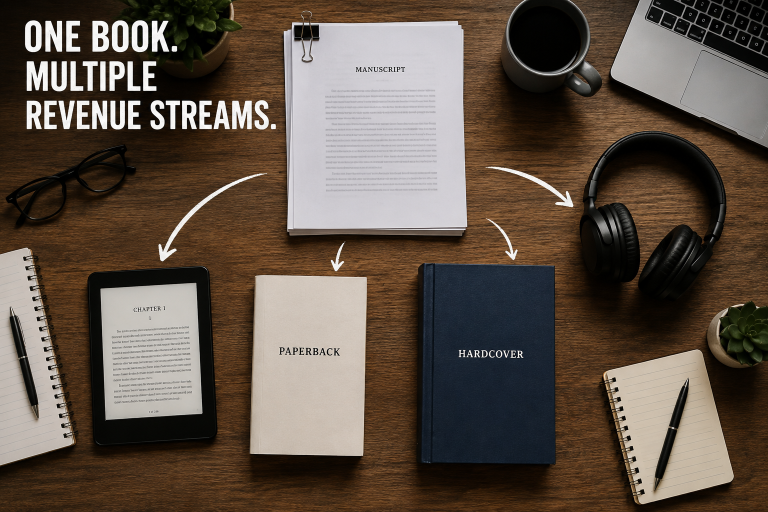
I talked about that distinction in One Book, Multiple Revenue Streams: Why I Publish in Every Format I Can.
An ebook, paperback, hardcover, and audiobook give readers different ways to experience the same intellectual property.
Publishing wide answers another question:
Where can readers find it?
Those two strategies can work together.
A book might exist in several formats.
Those formats might then be available through several different channels.
That creates more potential doors into the same catalog.
But the goal isn’t to collect platforms.
The goal is to create reasonable distribution options without making the business unnecessarily difficult to manage.
Amazon Can Be Important Without Being Everything
There is no point pretending Amazon isn’t important to independent publishing.
It is.
Readers already shop there.
The infrastructure exists.
Print-on-demand makes physical publishing accessible without requiring me to order hundreds of books and store them somewhere.
There are good reasons independent authors use Amazon.
I use it too.
My issue isn’t with using a large platform.
My issue is with needing one platform so badly that I have no meaningful alternative if something changes.
Those are two very different things.
If Amazon produces most of the sales for a particular title, great.
I’ll take the sales.
But I don’t want that success to convince me that readers everywhere else don’t matter.
And I don’t want to confuse:
This platform currently performs best
with:
This is the only platform worth having.
Those statements aren’t the same.
Exclusivity Is a Business Decision
There are situations where an author may intentionally choose exclusivity.
That can be a legitimate strategy.
A platform may offer benefits in exchange for keeping a digital edition exclusive for a period of time. Depending on the book, the author, the audience, and the current opportunity, that tradeoff might make sense.
What I don’t think makes sense is treating exclusivity as the automatic default without understanding what you’re giving up.
You’re making a trade.
You may gain access to certain promotional or subscription opportunities.
In exchange, you may give up the ability to distribute that edition through competing retailers during the exclusivity period.
That doesn’t automatically make the deal good.
It doesn’t automatically make it bad.
It means you need to know why you’re doing it.
For me, the broader principle is simple:
If I’m going to give one company exclusivity, I want a reason.
Otherwise, I generally prefer having more than one legitimate path to the reader.
Different Readers Shop in Different Places
One of the simplest arguments for publishing wide is also one of the easiest to overlook.
Not everybody buys books from the same place.
Some readers are deeply embedded in one ecosystem.
Their library is there.
Their payment information is there.
Their devices are connected to it.
They’ve been buying books there for years.
Asking those readers to change their habits just because I chose a different retailer creates friction I don’t necessarily need.
If somebody prefers buying ebooks through Google, why would I want the only answer to be:
Go buy it somewhere else.
If somebody uses Apple’s ecosystem, why would I automatically want to exclude that reader?
I already wrote the book.
If distributing it through another legitimate channel is practical and the economics make sense, I would rather give the reader the choice.
It’s the same philosophy behind offering different formats.
I don’t want my personal reading habits to decide how everybody else should consume my work.
And I don’t want my personal shopping habits deciding where everybody else should buy it.
More Stores Don’t Automatically Mean More Sales
This is where I think people can oversell the idea of going wide.
Putting a book on another retailer doesn’t create a reader.
You can publish a book in ten places and sell zero copies in all ten.
Distribution is not demand.
Availability is not discoverability.
A retailer listing doesn’t automatically mean anyone knows the book exists.
That’s important because otherwise going wide can turn into a false sense of progress.
You spend hours creating accounts, entering metadata, uploading files, checking previews, setting prices, and organizing everything.
Then you think:
Look how much I’ve accomplished.
Maybe.
But the real question is whether those channels have a reasonable chance of contributing to the business.
That’s why I don’t believe in being everywhere simply because everywhere exists.
That larger business lesson is something I explore in You Don’t Have to Be Everywhere to Build a Business.
Publishing wide should expand opportunities.
It shouldn’t become an endless collection of accounts that eat up time and produce nothing.
Small Sales Still Count
At the same time, I don’t need every retailer to compete with my biggest one.
That’s another place where I think expectations matter.
Suppose one platform produces ten sales and another produces one.
The second platform didn’t fail just because it didn’t produce ten.
That was still a reader.
That was still revenue.
And if maintaining that distribution channel doesn’t require much additional work, that sale may be perfectly worthwhile.
This becomes even more interesting as the catalog grows.
One title might perform better on one retailer.
Another title might unexpectedly get traction somewhere else.
An audiobook might find listeners through a channel where the ebook never does much.
A nonfiction title might behave differently from fiction.
I don’t necessarily know ahead of time.
Publishing wide gives me the opportunity to learn from actual reader behavior instead of assuming I already know where every reader is.
A Catalog Changes the Math
Going wide becomes more interesting to me as the number of books grows.
If I had one book, one additional retailer would create one additional listing.
With a catalog, one additional distribution channel can potentially create another sales opportunity across many titles.
That doesn’t mean I should automatically upload the entire catalog everywhere.
It means the economics change.
A channel that produces only occasional sales from one title might look insignificant.
A channel that occasionally sells books across a larger catalog may become more meaningful.
This is one reason I increasingly think about the catalog as a whole rather than evaluating every title in isolation.
I discussed the format side of that in One Book, Multiple Revenue Streams: Why I Publish in Every Format I Can.
One manuscript can potentially earn through several formats.
Then a growing catalog multiplies the number of assets capable of producing those sales.
Wider distribution adds another dimension.
Now there are more formats, more titles, and more legitimate places where readers might discover them.
None of that guarantees income.
It simply creates more opportunities for the intellectual property I’ve already created to work.
I Don’t Want a Platform to Be My Business
This is probably the biggest philosophical reason I don’t like depending completely on one marketplace.
A platform is a tool for my business.
The platform is not my business.
Dill Duo Media is the business.
The books are mine.
The intellectual property is mine.
The website is part of the ecosystem I’m building around that work.
Retailers help connect the books with customers.
That’s valuable.
But there’s an important difference between using someone else’s marketplace and building your identity entirely inside someone else’s marketplace.
If the marketplace changes, I still want Dill Duo Media to exist.
If one retailer becomes less useful, I still want the books to exist elsewhere.
If one sales channel slows down, I want other doors into the ecosystem.
That’s also why I’ve become more interested in treating books as assets rather than uploads.
In One Book, Multiple Products: How Indie Authors Can Get More From Every Title They Publish, I talk about looking beyond the individual retailer listing and asking what else the underlying intellectual property can become.
That way of thinking naturally changes how I view distribution too.
The book doesn’t belong to the retailer.
The retailer is simply one place where the book can do its job.
Your Website Gives Everything a Home
This is where having my own website becomes important.
I don’t need DillDuoMedia.com to replace the retailers.
That’s not the point.
Retailers already have checkout systems, customer accounts, payment infrastructure, audiences, and established purchasing habits.
I can use those advantages.
What the Dill Duo Media website gives me is something different:
a central home for the brand.
Someone might discover me through a book.
Someone else might find an article.
Another person might arrive because of homeschool resources.
Another might find a story.
Those paths don’t have to stay separate.
The website can connect them.
A reader who discovers an article can explore my books.
Someone who discovers a book can eventually find the articles.
A person who arrives for one subject can discover something else in the ecosystem.
That matters because the website isn’t dependent on one individual book performing well.
It’s connecting the catalog, content, resources, and brand.
The retailers remain useful doors.
The website gives those doors somewhere to lead.
Wider Distribution Also Gives Me Information
Every platform gives me another piece of information about the market.
Maybe one book unexpectedly sells somewhere I didn’t expect.
Maybe another platform produces almost nothing.
Maybe a certain format performs differently depending on where it’s available.
Maybe a title gets discovered internationally.
Maybe one marketplace isn’t worth the administrative effort at all.
That’s information.
I don’t have to guess forever.
I can look at what actually happens.
The important part is not becoming emotionally attached to the idea that because I spent time setting up a platform, I have to keep using it forever.
Businesses change.
If a distribution channel makes sense, use it.
If it stops making sense, reevaluate it.
Publishing wide isn’t a religion.
It’s a strategy.
There Is a Cost to Going Wide
The obvious downside is management.
Every platform can introduce another account.
Another dashboard.
Another password.
Another tax setup.
Another payment schedule.
Another set of metadata.
Another pricing system.
Another royalty report.
Another set of rules.
Another place where something can change.
Now multiply that by multiple books.
Then multiply it again by ebooks, paperbacks, hardcovers, and audiobooks.
This can get complicated fast.
That’s why wider distribution only works well if the back end of the publishing business becomes organized too.
I don’t want to rely on memory to tell me which version of a book is where.
I don’t want to search through folders trying to determine which cover belongs to which edition.
I don’t want to discover six months later that one retailer still has outdated metadata because I forgot I uploaded the book there.
As the catalog grows, systems stop being optional.
That’s a big part of What Publishing More Books Taught Me About Building Systems Instead of Starting Over.
The goal isn’t to create a complicated system for the sake of having one.
The goal is to make the complicated parts of publishing easier to manage.
Keep Your Own Copies of Everything
Going wide also reinforces something else I’ve learned:
I want my own copy of the assets.
The manuscript.
The EPUB.
The print PDF.
The cover files.
The audiobook files.
The descriptions.
The metadata.
The promotional images.
Whatever I created.
I don’t want the only usable copy of something living inside a retailer account.
If another legitimate distribution opportunity comes along, I want to be able to evaluate it without rebuilding the book from scratch.
That gives me flexibility.
It also reduces the psychological power any individual platform has over the business.
If I have my files, my records, my website, my catalog information, and my intellectual property organized, moving or expanding becomes much easier.
That’s part of being independent.
Not because I refuse to use platforms.
I use them.
But I want to use them from a position where I still control the underlying assets.
Don’t Confuse Diversification With Randomness
There is a difference between diversification and throwing things everywhere.
Diversification has a reason.
Randomness doesn’t.
If I distribute through another retailer because it reaches readers I might otherwise miss, that’s a reason.
If I create another format because readers actually consume books that way, that’s a reason.
If I maintain a website because I want a central home connecting the ecosystem, that’s a reason.
If I open seventeen accounts simply because somebody posted a list titled 17 Places Every Author MUST Sell Their Book, that’s not necessarily a strategy.
That’s how you end up spending more time maintaining the business than creating the things the business is supposed to sell.
I’ve learned this lesson outside publishing too.
Every opportunity has a cost.
Even free platforms cost time.
And time is something I can’t duplicate.
That’s why You Don’t Have to Be Everywhere to Build a Business fits directly beside this article.
There’s no contradiction between saying don’t put all your eggs in one basket and saying don’t try to be everywhere.
Those ideas actually belong together.
The goal is enough diversification to reduce unnecessary dependence without creating so much complexity that the diversification itself becomes the problem.
Wide Doesn’t Have to Mean Everything, Everywhere, Forever
I think this is where the strategy becomes much more practical.
Publishing wide doesn’t require some permanent promise that every book will be available through every possible retailer for the rest of its life.
Different books can have different strategies.
A particular title might temporarily benefit from exclusivity.
Another might make more sense wide from the beginning.
One format might be widely distributed while another isn’t.
A retailer might make sense today and stop making sense later.
A new distribution opportunity might appear.
The strategy can change.
That’s part of being independent too.
I don’t have to make one publishing decision today and pretend it has to govern every book I write for the next twenty years.
I can evaluate the book.
Evaluate the platform.
Evaluate the economics.
Evaluate the workload.
Then make the decision that makes sense.
Going Wide Doesn’t Replace Marketing
There’s another thing I don’t want to pretend.
Publishing wide doesn’t solve marketing.
A book sitting unnoticed on five retailers is still a book sitting unnoticed.
The website matters.
Articles matter.
Search visibility matters.
Social content can matter.
Word of mouth matters.
The book itself obviously matters.
Distribution gives readers somewhere to buy.
Marketing and discoverability help readers find the book in the first place.
Those jobs overlap, but they aren’t identical.
This is one reason I like connecting the publishing side with the larger Dill Duo Media ecosystem.
An article doesn’t have to directly sell a book to be useful.
It can introduce somebody to the brand.
A book doesn’t have to lead directly to another book.
It can introduce somebody to the website.
A social post might lead to an article instead of a sales page.
Those different entry points can eventually connect.
I’m much more interested in building that network than repeatedly posting:
Here’s my book. Buy it.
I Still Have to Write the Next Book
There is one danger in all of this.
Publishing can become an endless project.
You can spend forever adjusting prices.
Changing metadata.
Adding retailers.
Creating formats.
Checking dashboards.
Building graphics.
Tweaking descriptions.
Watching analytics.
At some point, the publishing business can prevent you from writing.
I don’t want that.
That’s why Write Your Book Your Way—and Then Write the Next One remains part of my philosophy.
The existing catalog deserves opportunities.
But the catalog also needs new intellectual property.
The goal isn’t to spend the next three years squeezing every theoretical possibility out of one book.
It’s to build a system where the books I’ve already created can keep working while I create the next thing.
That’s the balance I’m after.
Independence Doesn’t Mean Doing Everything Alone
The word independent can sometimes make it sound like the goal is to avoid every outside company.
That’s not what independent publishing means to me.
I use platforms.
I use retailers.
I use distribution services when they make sense.
I use technology.
I use tools that make the work easier.
Independence isn’t refusing help.
It’s maintaining enough control over the underlying business that no single outside company becomes the business itself.
That’s why owning the files matters.
That’s why having the website matters.
That’s why understanding where the books are distributed matters.
That’s why maintaining more than one reasonable route to readers matters.
I don’t need to own the bookstore.
I need to own my work.
I’m Building a Catalog, Not Betting Everything on One Store
That’s really what this comes down to.
I’m not trying to predict which retailer will dominate independent publishing five years from now.
I’m not trying to predict where every future reader will shop.
I’m not assuming that a platform that’s useful today will always operate exactly the same way.
I can’t control those things.
What I can control is how dependent I allow my business to become.
I can create the books.
I can preserve the files.
I can build the catalog.
I can maintain Dill Duo Media as the home connecting the work.
I can evaluate different formats.
I can evaluate different retailers.
I can decide when exclusivity makes sense and when it doesn’t.
And I can keep writing.
If one platform becomes the biggest source of sales, that’s fine.
I hope it sells a lot of books.
But I don’t want one company holding every egg simply because that happened to be the easiest place to start.
I would rather build multiple reasonable paths to the reader and let the catalog grow across them.
Not everywhere.
Not blindly.
Not because more platforms automatically mean more money.
But wide enough that one company’s decision doesn’t automatically become mine.
That’s what publishing independently means to me.