
By Christopher Dill
Writing a book is the hard part.
That’s something I’ve thought about more and more as my catalog has grown.
You spend the time developing the idea. You write thousands—or tens of thousands—of words. You revise it. You format it. You create a cover. You publish it.
After doing all of that, why would I want the finished book to have only one way to make money?
That’s why I’ve gradually developed a pretty simple philosophy with my books:
If a format makes sense for the book and I can reasonably produce it, I want the book available in that format.
Ebook.
Paperback.
Hardcover when appropriate.
Audiobook.
And, where it makes sense, additional digital marketplaces.
I’m not writing a different book every time.
I’m taking intellectual property I’ve already created and giving people more ways to buy and experience it.
Different Readers Want Different Things
I read ebooks.
Other people hate reading on screens.
Some readers love having a physical paperback in their hands.
Others want the hardcover.
And there are people who don’t have much time to sit down and read at all, but they’ll listen to an audiobook while driving, exercising, cleaning the house, working, or doing just about anything else.
If I only publish an ebook, I’ve made a decision for all those other people.
I’ve essentially told the paperback reader:
This book isn’t available the way you like to read.
I’ve told the audiobook listener the same thing.
That doesn’t make much sense to me when I already did the hardest part.
I wrote the book.
And that’s one reason I don’t think there is one universal answer to how an author should publish a book. I’ve written before about why I believe you should Write Your Book Your Way—and Then Write the Next One. The same philosophy carries into formats. The book has to make sense for the book, the author, and the readers you’re trying to reach.
One Manuscript Can Become Several Products
This is where I think independent authors sometimes look at publishing backward.
We naturally think about every edition as another project.
And technically, it is.
A paperback needs formatting.
A hardcover may need different cover dimensions.
An audiobook needs narration.
An ebook needs an EPUB or another appropriate digital file.
But none of those require me to invent the underlying book again.
The ideas already exist.
The chapters already exist.
The research is already done.
The story has already been written.
I’m adapting an existing asset.
That means a single manuscript can potentially become several products without requiring several completely separate creative projects.
That’s leverage.
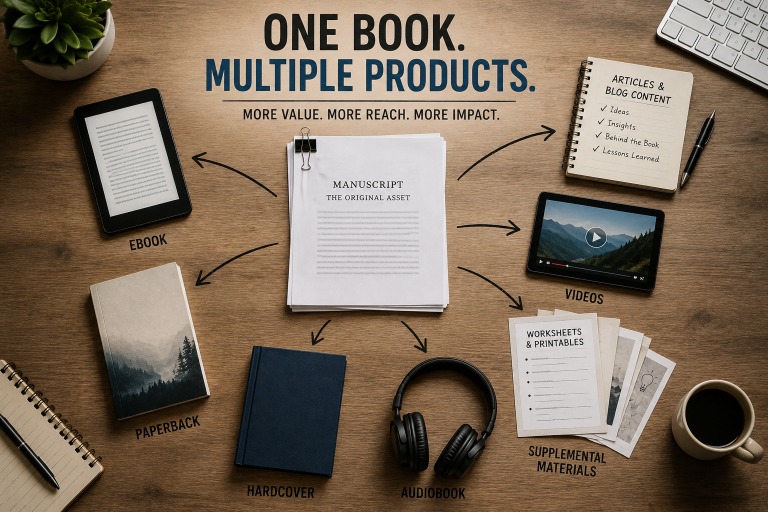
There is a broader version of this idea too. A book can sometimes become more than additional editions. Depending on the title, the underlying intellectual property may naturally support articles, supplemental material, bundles, read-alongs, educational resources, or other products.
That’s something I explore more deeply in One Book, Multiple Products: How Indie Authors Can Get More From Every Title They Publish.
The distinction matters because getting more revenue streams from a book and turning intellectual property into additional products are related ideas, but they aren’t exactly the same thing.
For this article, I’m talking primarily about something simpler:
I already wrote the book. How many reasonable ways can I give somebody to buy that book?
Print-on-Demand Changed the Equation
There was a time when publishing physical books meant thinking about print runs, boxes of books, storage space, and upfront inventory costs.
Print-on-demand changes that for independent authors.
Amazon KDP, for example, allows authors and publishers to offer paperback and hardcover editions that are printed when customers order them.
I don’t have to fill a room with 500 copies of a book hoping somebody eventually buys them.
That makes offering multiple physical formats much easier to justify.
If someone wants the paperback, it’s there.
If the book has a hardcover edition and somebody wants that instead, it’s there.
If nobody orders a particular format today, I’m not sitting on a pile of unsold inventory.
For a small independent publisher, that’s powerful.
It also changes how I think about the difference between ebook, paperback, and hardcover pricing.
An ebook doesn’t have the same physical printing cost attached to every copy. A paperback does. A hardcover generally has a higher production cost still.
So these aren’t simply three buttons with three arbitrary prices attached to the same manuscript.
They’re different products with different costs, different reader expectations, and different royalty structures.
That’s why I don’t think book pricing should begin with:
What’s the cheapest price I can put on this?
The better question is what price makes sense for that particular edition after considering the format, production cost, royalty structure, market, and value of the book.
The ebook can serve the reader who wants immediate digital access.
The paperback can serve somebody who wants an affordable physical copy.
The hardcover can serve the reader who wants a more durable or premium physical edition.
One doesn’t have to replace the others.
They can coexist.
Audiobooks Added Another Layer
Audiobooks were the format that used to feel the most difficult to scale.
Traditional audiobook production can introduce another substantial expense. Recording, editing, mastering, and producing hours of finished audio can turn one more book format into a major investment.
That makes an independent author ask a reasonable question:
Will this particular book sell enough audiobooks to justify producing one?
More accessible audiobook-production tools have started changing that calculation.
I recently went through my existing catalog and created auto-narrated audiobook editions for many of my books through Google Play Books.
Suddenly, books that had already existed in ebook and print formats had another potential revenue stream.
The manuscript hadn’t changed.
The intellectual property hadn’t changed.
I simply gave the same work another format.
That’s exactly what I’m talking about.
And the process itself taught me something important: not every audiobook is the same kind of product.
A long novel can become hours of listening.
A shorter nonfiction book may become a much more focused audio experience.
A children’s book may be extremely short in audio because the original book was designed to be a short illustrated reading experience in the first place.
That doesn’t automatically make one useful and another useless.
It means the format has to make sense for the underlying book.
Sometimes the audiobook can stand on its own.
Sometimes audio might make more sense as part of a larger reading experience.
Again, I’m not interested in creating formats merely so I can say they exist.
The format needs a reason to exist.
I’m Not Expecting Every Format to Sell Equally
This is important.
Publishing in multiple formats doesn’t mean I expect every edition of every book to sell.
Maybe one title sells mostly as a paperback.
Maybe another gets more ebook readers.
Maybe a particular subject works unusually well as an audiobook.
I don’t know until people start making those choices.
That’s part of why I don’t want to make the choice for them.
If I only offer the paperback because I assume that’s what people want, I never find out whether there was an audiobook audience.
If I only publish the ebook because it’s easy, I never find out how many people wanted a physical copy.
If I skip a hardcover because I personally wouldn’t buy one, I’m using my own buying habits to decide what every potential reader wants.
I would rather put reasonable options in the marketplace and let readers tell me what they prefer.
That doesn’t mean blindly creating every possible format for every title.
A highly visual book might make little sense as an audiobook.
A short practical guide might not need an expensive hardcover.
Another book might work perfectly in all four major formats.
The content should have some say in the decision.
Small Revenue Streams Can Add Up
I don’t need every format to become a bestseller for this strategy to make sense.
Suppose an audiobook sells occasionally.
Suppose a paperback sells occasionally.
Suppose Google Play produces a few ebook sales.
Suppose Amazon produces some more.
One individual stream might not look impressive.
But I’m not building one stream.
I’m building a catalog.
That’s an important distinction.
When you have one book and one format, you’re depending heavily on that one product.
When you have a growing catalog and several formats for many of those books, you create more opportunities for something to sell.
A sale here.
Another one there.
A different book next week.
A different format next month.
That’s much closer to how I think about Dill Duo Media.
I don’t need one product to carry the entire business.
I want a lot of assets capable of contributing.
That doesn’t mean a catalog automatically produces meaningful income simply because it is large. A book still needs readers. It still needs to be discoverable. People still need a reason to buy it.
More formats don’t magically create demand.
But if demand exists, I don’t want an unnecessary lack of format options standing between the reader and the book.
A Sale Doesn’t Have to Come From the Format I Expected
This is another reason I like giving readers options.
As an author, I can make educated guesses about which format will perform best.
But they’re still guesses.
Maybe I think a book is primarily an ebook product and somebody orders the paperback.
Maybe I expect the paperback to be the main edition and somebody discovers the audio.
Maybe a reader encounters the book on one marketplace and buys it somewhere else.
The customer’s decision doesn’t have to match the path I imagined when I published the book.
That is actually part of the benefit.
I’m creating options and allowing the market to tell me which ones people use.
Over time, those choices can also teach me something about the catalog.
If certain kinds of books consistently perform better in one format, that’s useful information.
If another format rarely gets touched, that’s information too.
I would rather learn from actual reader behavior than eliminate the option based entirely on my assumptions.
I Don’t Want One Platform Carrying Everything Either
The same philosophy extends beyond formats.
I don’t particularly like having all my eggs in one basket.
I’ve learned that from more than publishing.
I’ve seen it in gig work.
I’ve seen it in resale.
Platforms change.
Policies change.
Algorithms change.
Companies change what they promote, what they pay, what they allow, and sometimes whether they’ll let you continue using the platform at all.
If everything depends on one company, that company has an enormous amount of control over your business.
So when it makes sense, I prefer going wide.
Amazon can be part of the publishing business without being the entire publishing business.
Google can be part of it.
Apple can be part of it.
Other marketplaces can be part of it.
And DillDuoMedia.com can be the central place connecting everything.
That’s not because I expect every platform to perform equally.
They won’t.
It’s because I don’t necessarily know today where somebody will discover one of my books tomorrow.
I go into the distribution side of this much more deeply in Why I Publish My Books Wide Instead of Putting All My Eggs in One Basket.
There are tradeoffs.
There can be exclusivity considerations.
There are administrative costs to maintaining multiple platforms.
And being available everywhere simply for the sake of saying you’re everywhere isn’t automatically smart.
But as a general business principle, I like having more than one legitimate path between my work and the people who might want it.
Going Wide and Publishing in Multiple Formats Aren’t the Same Thing
I think this distinction is worth making because the two ideas can easily get mixed together.
Multiple formats means giving readers different ways to experience the same book.
Ebook.
Paperback.
Hardcover.
Audiobook.
Going wide means making the book available through more than one retailer or distribution channel when that makes sense.
Those strategies can work together, but they’re separate decisions.
I can have several formats on one platform.
I can have one format distributed across several platforms.
Or I can have multiple formats available through multiple channels.
The more combinations I create, though, the more important it becomes to know what I actually have, where it is, what it costs, and which files belong to which edition.
That’s where another part of publishing becomes increasingly important.
Systems.
More Formats Create More Management
Every new edition creates work.
Maybe not the same amount of work as writing the book, but work nonetheless.
Now I have another file.
Another cover size.
Another price.
Another listing.
Another set of metadata.
Possibly another retailer.
Possibly another agreement.
Possibly another royalty structure.
Do that with one book and it’s manageable.
Do it across a growing catalog and suddenly you’re managing a lot of moving pieces.
That’s one of the things publishing more books has taught me: the creative work can stay creative, but the repetitive business work needs a system.
That’s the larger subject behind What Publishing More Books Taught Me About Building Systems Instead of Starting Over.
I don’t want to figure out where an EPUB belongs every time I create one.
I don’t want to wonder which cover is the paperback cover.
I don’t want to search through random folders trying to determine which audiobook file is final.
I don’t want my memory to be the only record of where a title is distributed.
The more opportunities I create for a book, the more important organization becomes.
The Website Becomes the Hub
This is one reason building Dill Duo Media as an ecosystem became increasingly important to me.
Marketplaces are useful.
They’re where people already shop.
But I don’t own Amazon.
I don’t own Google.
I don’t own Etsy.
I do control Dill Duo Media.
That means the website can connect the pieces.
Someone can discover a book through one marketplace, eventually find Dill Duo Media, and discover other books, articles, resources, and projects.
Someone else may find an article first and then explore my books.
Another person may enter the ecosystem through something completely different.
The individual platforms become doors.
The brand is the building.
That’s a much different way of looking at publishing than simply uploading an ebook somewhere and waiting for royalties.
It also means a book can keep creating opportunities beyond the retailer listing itself.
An article can introduce somebody to a subject I’ve written about.
A social post can introduce somebody to the article.
The article can introduce them to Dill Duo Media.
The website can introduce them to the book.
The reader can then choose where and how they want to buy it.
That’s an ecosystem.
And that’s much more interesting to me than treating every book as an isolated product sitting on somebody else’s marketplace.
This Is Also Why I Save Everything
There’s another side to publishing in multiple formats: organization.
Every additional format creates another asset.
Manuscripts.
EPUB files.
Print PDFs.
Paperback covers.
Hardcover covers.
Audiobook files.
Promotional images.
Descriptions.
Metadata.
That can become a mess quickly if you don’t keep it organized.
I’ve learned to preserve those files because I don’t want a marketplace to be the only place where my finished work exists.
If I spent the time creating an asset, I want a copy of it.
That way, when another legitimate opportunity appears, I’m not rebuilding everything from scratch.
I can go into the archive and pull what I need.
Maybe a new retailer becomes worth considering.
Maybe I decide to create another edition.
Maybe a cover needs updating.
Maybe I need the original description.
Maybe I want to revisit a title two years later.
The work I already completed should still be available to me.
That’s another place where What Publishing More Books Taught Me About Building Systems Instead of Starting Over connects directly to this strategy.
The system isn’t there to make publishing feel corporate or complicated.
It’s there so I don’t have to keep solving the same damn problem every time I touch one of my books.
The Book Is Bigger Than Any One Edition
This may be the biggest change in how I’ve learned to think about publishing.
The paperback isn’t the book.
The ebook isn’t the book.
The audiobook isn’t the book.
They’re editions of the book.
The real asset is the intellectual property underneath them.
Once I started looking at it that way, publishing in multiple formats made much more sense.
I don’t have to ask:
Which format should this book be?
I can ask:
Which formats make sense for this book?
Sometimes the answer might be two.
Sometimes it might be four.
There isn’t a rule saying every title needs everything.
But when another format is practical, affordable, and appropriate, I see very little reason to leave that opportunity sitting there.
And once you start looking at the book as intellectual property instead of one specific file or physical object, another question naturally follows:
What else can this book become?
That’s where One Book, Multiple Products: How Indie Authors Can Get More From Every Title They Publish takes this idea in a different direction.
Some books may naturally support supplemental products.
Some can generate useful articles.
Some children’s books might work as read-alongs.
Some nonfiction books might support worksheets or companion material.
Some books shouldn’t become anything else at all.
I don’t want to confuse creating another edition of the book with creating another product from the intellectual property.
Both can be valuable.
They’re just different strategies.
Don’t Create Formats Just to Create Formats
There is a point where this strategy can turn into busywork.
I don’t want that.
If I spend three days creating an edition nobody needs, for a book that doesn’t fit the format, simply because somebody online told me every author needs it, I haven’t necessarily expanded the business.
I may have just created more work.
The additional format needs some reasonable justification.
Does it serve readers who consume books differently?
Does it make the title more accessible?
Does it create a legitimate additional sales opportunity?
Can I produce it at a cost that makes sense?
Does the book actually work in that format?
If the answer is no, I don’t need to force it.
This is especially important as the catalog grows because every new format doesn’t only create an opportunity.
It creates something else to manage.
More files.
More metadata.
More prices.
More retailer listings.
More things that may eventually need updating.
There’s a balance.
I want to give the book opportunities.
I don’t want to create administrative clutter for no reason.
More Opportunities Don’t Mean Chasing Everything
The same balance applies to platforms.
There are always more places I could potentially put something.
Another marketplace.
Another social network.
Another sales channel.
Another promotional tool.
Another service.
At some point, opportunity becomes distraction.
That’s why You Don’t Have to Be Everywhere to Build a Business is the other side of this strategy.
Giving an existing asset more legitimate opportunities to work does not mean I believe a business has to chase every platform or opportunity that exists.
I want to use the opportunities that make sense.
I want to preserve my ability to reach readers through more than one route.
But I also have to consider my time.
Uploading a book somewhere is not necessarily the end of the work.
Listings need to be maintained.
Information changes.
Prices change.
Files get updated.
Policies change.
The more places I put something, the more places I may eventually need to manage it.
So diversification needs to be intentional.
More isn’t automatically better.
Better opportunities are better.
Create Once, Give It More Opportunities to Work
I’m still writing new books.
I’m still developing new ideas.
But building a publishing business isn’t only about constantly creating the next thing.
Sometimes growth comes from looking at something you’ve already created and asking whether you’re actually using the asset to its full potential.
That’s what multiple formats do for me.
I can spend months writing a book once.
Then that work can potentially continue earning through an ebook, paperback, hardcover, audiobook, and whatever legitimate publishing opportunities make sense later.
No format guarantees a sale.
No marketplace guarantees an audience.
And publishing more editions doesn’t magically create demand.
But every appropriate format gives a potential reader another way to say yes.
That’s the part I keep coming back to.
I don’t have to write the same book four times to create four editions.
I don’t have to know in advance which format every reader will choose.
I don’t need every edition to perform equally.
And I don’t need one retailer to carry the entire weight of the catalog.
I need to create good intellectual property, preserve the assets I’ve created, make intentional decisions about where and how they’re available, and give readers reasonable ways to access them.
I’ve already done the hardest part.
I wrote the book.
Now I want to give that book as many reasonable opportunities to work for me as I can.