
By Christopher Dill
Pricing a book is one of those things that sounds simple until you’re the person who has to type the number into the box.
You wrote the book.
You formatted it.
You created the cover.
You published it.
Now what is it worth?
$2.99?
$4.99?
$9.99?
$14.99?
$24.99?
There isn’t one number that works for every book, and I’ve become increasingly convinced that there are two mistakes independent authors can make with pricing.
You can price yourself out of the market.
Or you can become so focused on being cheap that you undervalue the thing you created.
I’m not interested in either extreme.
I want my books priced competitively enough that a reader can look at one and reasonably decide to give it a chance.
But I’m also running a publishing business.
The goal isn’t to become the cheapest author on the internet.
Cheap Isn’t Automatically Competitive
There’s an assumption in online business that lowering the price makes something easier to sell.
Sometimes it does.
But “lower” and “better” aren’t the same thing.
If everybody selling a comparable ebook is somewhere around $4.99 and I list mine for 99 cents, I’ve certainly created a price difference.
But what does that difference communicate?
Maybe it creates an impulse purchase.
Maybe it attracts a reader who wouldn’t otherwise try the book.
Or maybe the reader wonders why mine is so cheap.
Price is part of how people perceive a product.
Books aren’t exempt from that.
I don’t believe an independent author has to apologize for being independent by automatically charging less than everybody else.
Expensive Isn’t Automatically Premium Either
The opposite mistake is just as easy.
You spend months writing something.
You’re proud of it.
You know how much work went into it.
So you decide:
This paperback is worth $29.99.
Maybe it is.
But the customer doesn’t know how many nights you stayed awake writing Chapter 12.
They’re looking at your book beside other books.
They see the cover.
The description.
The reviews.
The author.
The page count.
The subject.
The format.
And the price.
Your personal investment matters to you.
Market expectations matter to the customer.
A price has to make sense from both directions.
I Start With the Book, Not a Universal Formula
I don’t think every ebook I publish needs the same price.
I don’t think every paperback should cost the same amount.
And I definitely don’t think a 50-page focused guide should automatically be priced like a 400-page novel simply because they’re both paperbacks.
I look at the individual book.
What kind of book is it?
How long is it?
What’s the subject?
Who is the intended reader?
What do comparable books cost?
What does the physical edition cost to manufacture?
What royalty does the retailer or distributor offer under the applicable arrangement?
What would I personally expect to pay for something similar?
Those questions are more useful to me than:
What’s the perfect price for an indie book?
There isn’t one.
Ebook, Paperback, and Hardcover Pricing Are Different Decisions
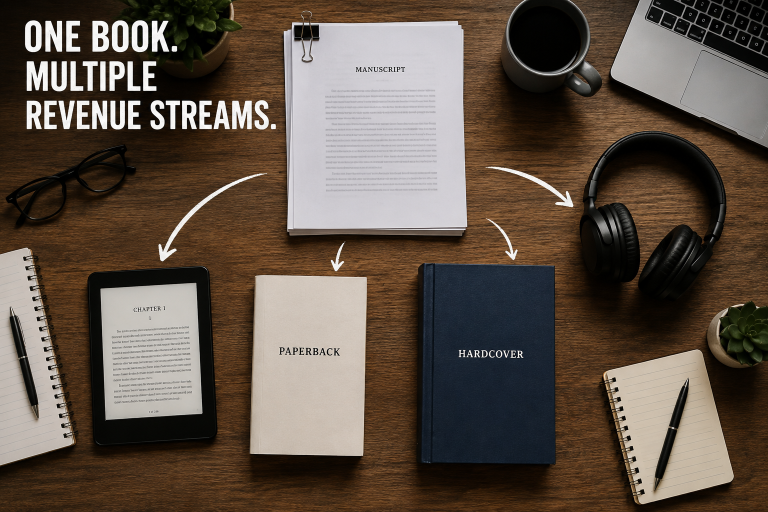
One of the reasons I don’t believe in a universal pricing formula is that an ebook, paperback, and hardcover can contain the same underlying work while having very different economics.
An ebook doesn’t require a physical copy to be manufactured every time someone buys one.
That doesn’t mean the entire retail price becomes my income. The retailer or distributor still operates under its own royalty structure, and depending on the arrangement, other applicable costs or fees can affect what ultimately reaches the publisher.
But there isn’t a paperback coming off a printing press every time someone downloads the ebook.
Print changes the equation.
With a paperback, I have to think about the retail and distribution structure and the cost of physically producing the book.
Paper costs money.
Ink costs money.
Printing costs money.
That manufacturing expense directly affects how much room exists between what the reader pays and what I ultimately receive.
Hardcover pricing follows the same basic principle, but the physical edition generally costs more to manufacture.
That means I can’t look at an ebook priced at $4.99 and say:
Well, the paperback contains the same words, so it should also cost $4.99.
The economics wouldn’t make sense.
The same applies in reverse. A $24.99 hardcover doesn’t mean I’ve suddenly decided the words themselves are worth five times what they were worth in the ebook.
They’re different products built from the same intellectual property.
So instead of asking only:
What should I charge for this book?
I need to ask:
What makes sense for the ebook?
What makes sense for the paperback after its production economics?
What makes sense for the hardcover after its higher manufacturing cost?
Those answers can be significantly different without the pricing being inconsistent.
A $4.99 ebook, $14.99 paperback, and $24.99 hardcover, for example, can represent a logical pricing ladder rather than three contradictory judgments about what the writing is worth.
That’s why I price the format, not just the manuscript.
My Ebook Pricing Has a Purpose
For many of my books, I’ve found the $4.99 range comfortable for ebooks.
That isn’t a universal recommendation.
It’s a price point that has made sense for much of my catalog.
It’s high enough that I’m not treating the book like disposable content.
It’s low enough that someone interested in the subject can reasonably take a chance on an author they may not have read before.
Some books may justify something different.
That’s fine.
I don’t want the catalog trapped inside a rigid formula.
But I do want some internal logic to the pricing.
If two books are similar in scope, format, and value, wildly different prices should have a reason behind them.
Print Has a Floor That Ebooks Don’t
Physical books change the equation because somebody has to manufacture the thing.
Paper costs money.
Ink costs money.
Printing equipment costs money.
Fulfillment costs money.
The retailer and other participants in the transaction have their own economics.
By the time everybody involved takes their piece, there is a point below which lowering the retail price stops being a clever marketing strategy and starts destroying the economics of the product.
That’s why I look at printing costs before deciding what I want a paperback to cost.
I don’t want to discover after a sale that I basically donated a book to somebody.
That doesn’t mean I automatically charge as much as possible.
It means I need to know where the floor is before deciding where I want the price to sit above it.
But I Still Have to Look at the Shelf Beside Me
Production costs don’t give an author permission to ignore the market.
Imagine my paperback costs enough to produce that I decide I need to charge $27.99.
Then I search for comparable books and discover readers can choose among a dozen respected alternatives priced around $12 to $16.
I have a problem.
Maybe I need to reconsider the format.
Maybe I need to reconsider the page size or printing choices.
Maybe the economics simply don’t work.
What I can’t do is assume the reader owes me $27.99 because my production process is expensive.
The market doesn’t work that way.
Comparable Books Are Useful, but I Don’t Copy Them Blindly
I like looking at comparable titles.
Not because I need to find one author and copy their price.
I’m looking for the range.
If books similar in subject, length, and format tend to cluster around a particular price, that’s information.
It tells me what readers are already accustomed to seeing.
Then I can ask where my book belongs within that range.
Maybe I come in slightly lower because I’m still building an audience.
Maybe my book offers enough additional value to sit toward the upper end.
Maybe it’s shorter and belongs lower.
The comparison gives me context.
It doesn’t make the decision for me.
Royalties Matter More Than the Sticker Price
This is where authors have to start thinking like publishers.
The retail price is not your income.
If an ebook sells for $4.99, I don’t receive $4.99.
The retailer gets its share.
Depending on the platform, distribution arrangement, territory, and format, other costs or terms may apply.
Print books add manufacturing costs to that equation.
Audiobooks can operate under different royalty and retail models altogether.
So when I’m comparing prices, I’m also interested in:
What do I actually receive when this sells?
That’s the number that matters to the business.
A Higher Royalty Percentage Doesn’t Automatically Mean More Money
Percentages can also be misleading without context.
Suppose one arrangement pays a higher percentage but comes with conditions that don’t make sense for that particular book.
Another pays a lower percentage but reaches substantially more readers.
Another provides access to a different sales or subscription environment.
Another reaches customers I wouldn’t otherwise reach.
Which one is best?
There’s no answer based solely on the percentage.
Royalty rate × actual sales matters more than royalty rate by itself.
I’d rather understand the entire arrangement than brag about a percentage while making no money.
This Is Why I Save My Royalty Terms
As my catalog of books continues to grow across different formats and distribution channels, I don’t want to rely on memory.
I want records.
What royalty structure applied?
What price did I select?
What were the important conditions?
Were there printing costs?
Was the edition subject to exclusivity?
Which territories were included?
Those details can matter later.
That’s one reason I maintain a permanent publishing archive for my books.
Pricing isn’t an isolated decision.
It’s connected to distribution.
And as the catalog gets larger, remembering why I made a decision becomes almost as important as remembering what the decision was.
Going Wide Makes Pricing Discipline More Important
Publishing through multiple retailers gives readers more ways to discover my books, which is one reason I prefer wide distribution as a long-term strategy when it makes sense for the particular book.
But it also gives me more things to keep track of.
If an ebook is $4.99 in one store, I don’t want to accidentally leave it at $7.99 somewhere else for two years because I forgot about it.
That doesn’t mean every displayed price in every country will always match perfectly.
Currencies differ.
Taxes differ.
Retailer practices differ.
Sales happen.
But I want the underlying pricing strategy to be consistent.
If there’s a difference, I want it to be intentional.
Don’t Let an Old Price Become Your Current Strategy
Books can sit online for years.
That’s one of the great things about publishing.
It’s also why prices deserve occasional review.
Maybe I launched a book at one price.
Then I learned more.
Maybe the market changed.
Maybe I added another edition.
Maybe comparable titles moved.
Maybe production costs changed.
Maybe I realized the book was simply overpriced.
Or maybe I realized I had priced it lower than necessary.
Changing the price isn’t an admission that the original decision was stupid.
It’s managing the product.
I’ve changed prices when I thought another number made more sense.
I’d rather adjust than defend an old decision forever simply because I’m the person who made it.
A Sale Can Teach You Something
Sales are data.
They’re not perfect data.
One sale doesn’t prove a pricing theory.
Neither does one month without a sale.
But over time, patterns can tell you something.
If a book receives attention but never converts, price may be one thing worth examining.
If a price adjustment is followed by increased sales, that’s worth noticing.
Maybe the price wasn’t the only factor.
The cover may have changed.
The description may have improved.
Visibility may have increased.
The subject itself may have suddenly become more relevant.
Publishing decisions get better when they’re informed by what customers actually do instead of only what I hope they’ll do.
Don’t Confuse Revenue With Profit
This matters especially with print.
Selling a $15 paperback doesn’t mean I made $15.
The gross sale is one number.
The printing cost is another.
The applicable retail or distribution economics matter.
The royalty that ultimately reaches the publisher is what matters to me.
That’s why dropping prices blindly can become dangerous.
A $2 price reduction might not sound dramatic to the customer.
Depending on the production economics, it can represent a much larger percentage reduction in the author’s actual royalty.
You need to know the numbers.
Hardcover Pricing Has Different Expectations
Hardcovers are interesting because customers generally expect them to cost more.
They’re physically more expensive to manufacture.
They’re also commonly treated as the premium physical edition.
That gives me more pricing room than I generally have with a paperback.
But hardcover isn’t a magic word that makes any price reasonable.
I still look at production cost.
Book length.
Comparable editions.
The audience.
The difference between the hardcover and paperback.
If my paperback is $14.99 and my hardcover is $24.99, the customer can understand the basic hierarchy.
They have choices.
That’s useful.
Give Readers a Price Ladder
This is something I like about having multiple formats.
Not every reader has the same budget or preference.
Maybe someone wants the ebook.
Someone else wants the paperback.
Someone wants the premium hardcover.
Someone prefers audio.
Those formats naturally create different entry points.
Instead of trying to make one edition serve everybody, the catalog can offer options.
That’s another reason I don’t think about book pricing as one number.
I think about how the editions work together.
The ebook isn’t necessarily competing against my paperback.
The paperback isn’t necessarily competing against my hardcover.
They’re different ways for a reader to choose the same underlying work.
That format mix varies across the books in my current catalog, because not every title needs exactly the same combination of ebook, paperback, hardcover, and audio editions.
Audiobook Pricing Can Be Its Own World
Audiobooks complicate things further.
Different audiobook platforms and distribution arrangements can approach retail pricing, subscriptions, credits, royalties, and publisher control differently.
In some arrangements, the price a publisher suggests may not necessarily be the final price the customer sees.
That means I can’t simply take the paperback price and say:
Okay, audiobook is the same.
I need to understand the platform and distribution arrangement.
How long is the audiobook?
How does that retailer handle similar titles?
Do I control the retail price?
What royalty structure applies?
Is the audiobook sold individually, through credits, through subscription listening, or through some combination?
The format changes the economics.
Short Doesn’t Automatically Mean Worthless
Working through audiobook versions of my catalog also taught me not to judge everything solely by length.
Some focused nonfiction titles can produce relatively short audio runtimes.
A children’s book can be shorter still.
Meanwhile, a novel can run for many hours.
Obviously, those shouldn’t all be priced and packaged identically.
But the lesson isn’t:
Short = cheap. Long = expensive.
It’s:
What is the customer actually receiving?
A concise guide that solves a specific problem can have tremendous value.
A bloated 400-page book can have very little.
Length matters.
It just isn’t the only thing that matters.
Don’t Pad a Book to Justify the Price
This is one of my biggest problems with thinking entirely in terms of quantity.
If a book says what it needs to say in 100 pages, I don’t want to turn it into 250 pages of repetition just so the paperback looks thicker.
That’s not added value.
That’s added paper.
I’d rather price the book appropriately for what it is.
The same applies to audio.
If a focused audiobook delivers what it promised efficiently, artificially stretching it just to increase the runtime doesn’t make it better.
Readers’ time has value too.
Low Prices Can Become Hard to Escape
There’s another strategic issue with going extremely cheap.
Once readers become accustomed to seeing your books at 99 cents or $1.99, moving the catalog upward can become harder.
You’ve established an expectation.
That doesn’t mean low-price promotions are bad.
Free promotions can be useful.
Discounts can be useful.
Introductory pricing can be useful.
The question is whether the low price has a purpose.
A promotion is a strategy.
Permanent underpricing because you’re afraid nobody will buy the book is something else.
Free Can Make Sense When Free Has a Job
I’m not against giving books away either.
I’ve had books downloaded free.
That can introduce people to an author.
It can support a series.
It can create awareness.
It can make sense as a temporary promotion.
But I want free to have a reason.
If I’m giving something away, what am I trying to accomplish?
Discovery?
Email signups?
Series entry?
Reviews?
Audience building?
A promotion should serve the larger ecosystem.
Otherwise I’m not pricing strategically.
I’m just not charging.
Don’t Price From Fear
I think a lot of independent creators underprice because they’re afraid.
Who am I to charge $4.99?
Nobody knows me.
What if nobody buys it?
Maybe I should make it 99 cents.
I understand that uncertainty because publishing a book doesn’t come with a guarantee that anybody will buy it.
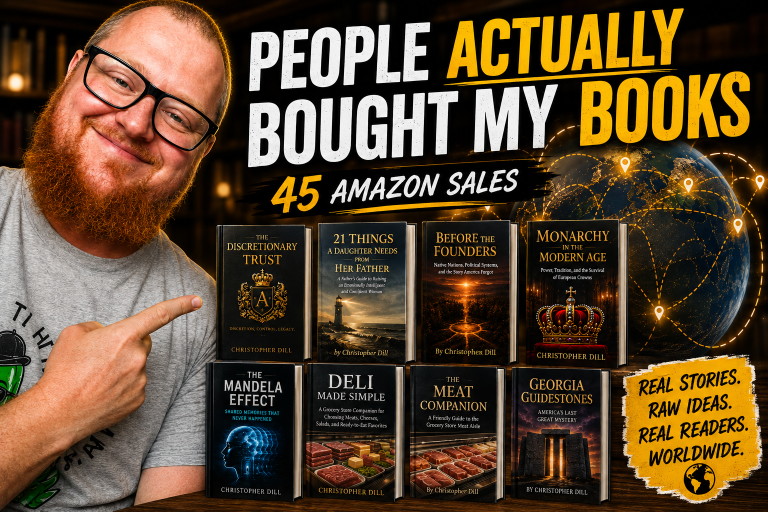
I’ve experienced the difference between wondering whether anyone would ever purchase something I wrote and eventually seeing my work reach actual readers. I talk more about that journey in I Didn’t Know If Anyone Would Buy My Books—Now They’re Sitting on Bookshelves Across the World.
But lowering the price doesn’t solve every marketing problem.
If nobody knows the book exists, making it cheaper doesn’t automatically make them discover it.
If the cover isn’t attracting attention, price isn’t necessarily the issue.
If the description doesn’t communicate why somebody should care, another $2 discount may accomplish nothing.
Pricing is one part of the sale.
It’s not the entire sale.
Don’t Price From Ego Either
Fear can push prices too low.
Ego can push them too high.
“I spent six months on this, so it’s worth $50.”
Maybe.
But your time investment isn’t the only measure of market value.
A reader doesn’t owe me compensation for every hour I spent learning how to format an ebook.
The book has to stand on its own.
That’s why I want a balance between respecting my work and respecting the market.
Price Is Part of Positioning
Every price tells the customer something.
A 99-cent ebook communicates something different from a $4.99 ebook.
A $9.99 paperback communicates something different from a $29.99 paperback.
A $24.99 hardcover creates different expectations from a $12.99 paperback.
None of those prices is inherently correct or incorrect.
They position the product differently.
That’s why pricing shouldn’t be the last random box you fill out before clicking Publish.
It’s part of how the book enters the market.
My Goal Isn’t the Highest Possible Price
I don’t want to extract the maximum possible amount from every person willing to buy one of my books.
That can become counterproductive.
If dropping a price slightly makes the book substantially more attractive while still leaving healthy economics, that’s worth considering.
I’d rather have a price that makes sense for both sides.
The reader gets value.
The publishing business gets paid.
That’s sustainable.
My Goal Isn’t the Lowest Possible Price Either
At the same time, I don’t want my competitive advantage to be:
Christopher’s books are always the cheapest.
That’s a terrible moat.
Somebody can always go lower.
Free exists.
My books have to compete on subject, story, usefulness, presentation, writing, branding, and value.
Price supports those things.
It shouldn’t have to replace them.
I Want Pricing to Make Sense Across the Catalog
As the catalog grows, consistency becomes increasingly important to me.
Not identical prices.
Logical prices.
A reader looking through several of my books shouldn’t feel like the numbers came out of a hat.
Shorter focused works may occupy one range.
Larger nonfiction may occupy another.
Fiction may behave differently.
Paperback, hardcover, ebook, and audio naturally create their own tiers.
The catalog should make sense as a whole.
And this connects to something broader about publishing: one title doesn’t have to carry everything by itself. That’s part of why I believe in writing your book your way and then writing the next one.
Each new book adds another product to manage, another potential reader entry point, and another piece of the larger catalog.
Pricing has to grow up alongside that catalog.
Review the Numbers Occasionally
I don’t think authors need to obsess over their book prices every morning.
That creates its own kind of paralysis.
But periodically?
Absolutely.
Look at the catalog.
Check current prices.
Look at royalties.
Check production costs.
Look at comparable titles.
See what’s actually selling.
See what’s not.
Make adjustments when the evidence gives you a reason.
Then go back to writing and running the business.
There’s No Perfect Price
That’s probably the most important thing I’ve learned about indie author book pricing.
There is no magical number that guarantees sales.
A $2.99 ebook can fail.
A $9.99 ebook can sell.
A $14.99 paperback can sell.
A $24.99 hardcover can sell.
A 99-cent book can sit untouched.
Price interacts with everything else:
The book.
The audience.
The cover.
The description.
The author.
The reviews.
The subject.
The competition.
The retailer.
The marketing.
The timing.
All I can do is make the most informed decision I can and adjust when necessary.
I Don’t Want to Race to the Bottom
Independent publishing gives me tremendous control.
I decide what to write.
I decide how to package it.
I decide where to distribute it.
And within the rules and options of the platforms I use, I have substantial control over pricing.
I don’t want to waste that freedom by assuming the answer is always:
Cheaper.
Sometimes cheaper is right.
Sometimes a price increase is right.
Sometimes nothing needs to change.
What matters is understanding why the number is there.
For me, the goal is straightforward:
Price the book competitively enough that the right reader can reasonably say yes, but high enough that I’m still treating the work and the publishing business like they have value.
Not the highest price possible.
Not the lowest price possible.
The price that makes sense for the book, the reader, and the business.
That’s the balance I’m after.