
By Christopher Dill
Ideas Have a Way of Disappearing
I’ve had ideas for as long as I can remember. Not just one kind of idea, either. A book idea can show up while I’m thinking about something completely unrelated. A business idea can grow out of a problem I’m trying to solve. An article can start with one sentence that gets stuck in my head. One thought connects to another, then another, and before long my mind has gone six directions at once.
For years, I made the same mistake a lot of people make when that happens: I trusted myself to remember it.
I’ll remember that later.
That sentence has probably cost me more ideas than I could ever count.
At the moment an idea arrives, it can feel impossible to forget. It’s clear. It’s interesting. Sometimes the whole thing seems obvious. You can almost see the finished version in your head. Then life keeps moving. You go to work. Somebody calls. You start thinking about something else. Another idea arrives and pushes the first one a little farther into the background.
A few days later, you might remember that you had an idea, but not the idea itself. That’s almost worse. You know there was something there. You know you were excited about it. You just can’t get back to it.
I’ve done that more times than I want to think about.
Eventually I realized I needed to stop treating my memory like a filing cabinet. I needed to save my ideas somewhere outside my own memory.
My brain is where the ideas happen. It doesn’t have to be where every idea is stored forever.

Save Your Ideas Before They Disappear
Once I stopped trusting myself to remember everything, my process changed.
I started putting things on the computer. Notes. Titles. Fragments. A paragraph that might become something. A question I wanted to explore. A thought about a book. A possible article. A business idea. Something I noticed that I didn’t want to lose.
Sometimes a file contains a lot. Sometimes it barely contains anything.
That doesn’t bother me.
The important part is that the thought exists somewhere outside my head.
Over the years, those files have accumulated. I honestly wouldn’t be surprised if I have 10,000 or more files scattered through what I’ve saved. That doesn’t mean I have 10,000 finished books waiting to be published. It means I’ve captured thousands of pieces of thought instead of demanding that every idea immediately become something complete.
Some of those files may eventually become books. Some may become articles. Some may become part of another project. Some might connect with an idea I haven’t even had yet. And some of them may never become anything at all.
That’s fine.
An idea doesn’t have to prove its value before you’re allowed to save it.
There Is a Relief in Getting an Idea Out of Your Head
Something happened when I started doing this that I didn’t really expect: it gave my mind some relief.
When I was trying to remember everything, part of me had to keep holding on to everything. I would mentally revisit an idea because I didn’t want to lose it. I would try to keep certain details alive in my memory. Meanwhile, new thoughts kept arriving.
Once the idea was saved, I didn’t have to do that anymore.
I could put it somewhere and let it go.
That’s a big deal for me because my mind is all over the place a lot of the time. I can be thinking about a book, a business problem, something I need to do later, a story from years ago, something involving my daughter, an article, a product, and five other things in the same stretch of time.
Writing an idea down doesn’t make my mind stop moving. It gives some of those thoughts somewhere else to live.
I don’t have to keep telling myself, Don’t forget this. Don’t forget this. Don’t forget this.
It’s saved.
I can move on.
An Idea Doesn’t Have to Know What It Is Yet
I think one of the biggest mistakes people make with ideas is trying to classify them too early.
They think, Is this enough for a book? Is this a good article? Can I sell this? Is this worth my time?
Sometimes I don’t know.
And I don’t need to know.
A thought can just be a thought for a while.
You might save three sentences today and discover six months from now that they belong inside something much bigger. You might have what you think is a book idea and later realize it’s really an article. You might save five unrelated notes and eventually notice that they aren’t unrelated at all.
That’s where things get interesting.
Ideas can grow after you save them. They can connect to other ideas. They can change as you change.
If you throw an idea away because it isn’t fully developed the day you have it, you never give it the chance to become anything else.
Sometimes the Missing Piece Shows Up Months Later
I’ve opened old files and seen something differently simply because time passed.
Maybe I know more now. Maybe I’ve experienced something since I wrote it. Maybe another idea came along that suddenly gives the old one context. Maybe I can finally see what I was trying to say.
That’s one of the reasons I don’t worry when every saved thought doesn’t immediately turn into finished work.
Time can be part of the creative process.
There are ideas that make more sense after you’ve lived with them. There are things you can write better after you’ve gotten some distance from them. There are connections you can’t force because you don’t know yet that the other half of the connection exists.
When the original thought is saved, you have something to return to.
When it isn’t, you’re hoping you’ll somehow recreate it later.
Sometimes you can. A lot of times you can’t.
The Same Thing Happens When I Write Books
This is also how I write books.
I can have an idea, start writing, and make real progress. Then I reach a point where I know I could technically keep going, but I don’t feel like the book is complete.
I could force an ending. I could push through just so I could say the manuscript was finished.
I don’t always want to do that.
Sometimes I stop.
I save it. I go work on something else. Maybe I come back a month later. Maybe six months later. Maybe a year later.
When I return, I’m not necessarily the same writer who walked away from it.
I’m reading what I wrote with a fresh set of eyes. I can see things I couldn’t see when I was buried inside the manuscript. I notice where something needs more explanation. I see a section I can make stronger. I understand a character differently. I realize two pieces should connect.
And sometimes I come back and think: Now I know the ending.
That doesn’t mean the book was abandoned. It means I wasn’t ready to finish it yet.
There is a difference.
I’ve learned not to treat every unfinished piece of writing as a failure. Some work needs distance. Some ideas need time. Sometimes the book needs you to go live a little more life before you know what to do with it.
Eventually, though, there comes a point when the book is ready and continuing matters more than endlessly working on the same project. That’s part of why I believe in writing your book your way—and then writing the next one.
Don’t Delete the Unfinished Stuff
That’s another reason I’m careful about keeping old files.
Something being unfinished today doesn’t mean it’s useless.
I don’t know what version of me is going to open that file later.
The person who returns to it a year from now may have learned something the person who started it didn’t know. I may have solved a problem somewhere else that turns out to be exactly what that manuscript needed. I may have developed a completely different idea that fits perfectly with the old one.
If I delete the unfinished work because I decided it wasn’t good enough yet, I eliminate that possibility.
I’d rather save it.
Storage is cheap. Recreating a forgotten idea isn’t.
Build Ideas on Top of Ideas
A book doesn’t always begin as a book.
Sometimes it begins with one observation.
Write that down.
Then you think of something related.
Add it.
A week later, another thought connects.
Add that too.
Maybe you start researching something because one of those notes raised a question. That research creates another idea. Then you remember something from your own life that belongs with it.
Now the little file isn’t so little anymore.
Eventually you can look at everything you’ve accumulated and realize there is a structure hiding inside it.
That’s when you start building.
You organize. You expand. You throw out what doesn’t belong. You connect the pieces that do. You ask what is missing.
The finished thing may look nothing like the original note.
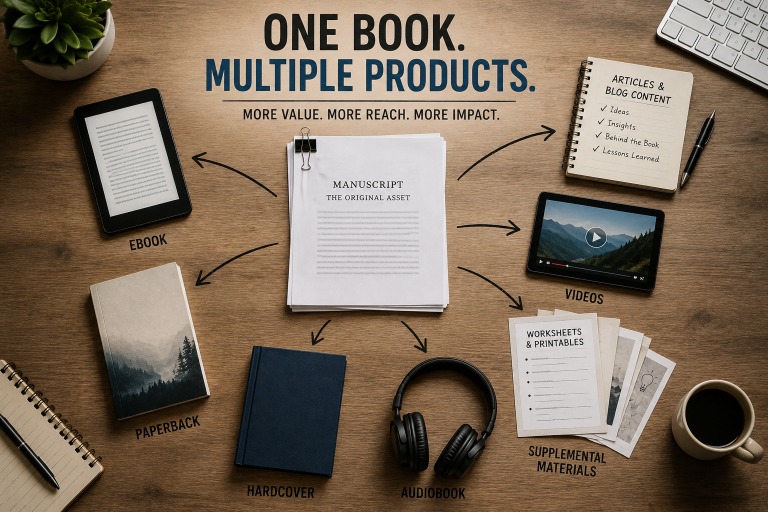
A number of projects that eventually became part of my published book catalog began much earlier as ideas, fragments, questions, or pieces that needed time before I knew what to do with them.
That’s okay.
The original note did its job. It kept the door open.
Dill Duo Media Grew From Connected Ideas Too
The same process eventually became bigger than my writing.
Dill Duo Media didn’t arrive in my head as a perfectly mapped-out ecosystem with every piece already decided.
It grew.
I’ve always done a lot of different things and had a lot of different interests. I write books. I create educational material. I work with resale. I write articles. I build things. I experiment with ideas. I solve problems because I need to solve them, and sometimes the solution creates another opportunity.
For a while, it was easy to see all of those things as separate.
Eventually I started looking at them differently.
Why do they have to be separate?
Why can’t the things I already enjoy doing connect under one umbrella?
One idea connected to another. Then another. The books connected to the website. The articles could connect readers to the books and resources. Educational materials became another part of the business. Other things I already did could have a place in the same ecosystem without pretending they were all identical.
Dill Duo Media itself became an example of what happens when you allow ideas to build on each other instead of demanding that every thought stay in its own little box.
And it’s still growing.
I don’t need to know every piece that will exist five years from now. I just need to keep recognizing useful connections when they appear.
You Don’t Need a Perfect System to Start
I don’t want the lesson here to become that you need some complicated productivity system.
You don’t.
You don’t need twelve apps, color-coded databases, a perfect folder structure, and a three-hour weekly review before you’re allowed to have an idea.
Use whatever you’ll actually use.
A document. A folder. A notes app. A file on your computer. Whatever makes it easy enough that when something hits you, you can capture it before life moves on.
You can organize it later.
I’d rather have a messy folder containing an idea than a beautiful organizational system containing nothing because I made capturing thoughts too complicated.
The habit matters more than the software.
Get it out of your head and put it somewhere you can find again.
Don’t Demand That Every Idea Make Money
This matters too, especially when you’re building a business or publishing books.
It’s easy to start evaluating every idea by asking what it can earn.
Can I sell it? Will people click it? Is there a market?
Those questions have their place. I run a business. Obviously I care whether things make money.
But I don’t want money to become the requirement for allowing myself to explore an idea.
Some ideas become products. Some become books. Some become articles. Some help me solve a problem. Some simply teach me something while I’m working through them.
You can’t always know which ideas will matter when they first arrive.
And sometimes the thing you almost dismissed becomes useful much later.
The same uncertainty continues after something becomes a finished book. I didn’t know whether anybody would buy what I was writing either, which made it especially meaningful when books I created eventually started reaching readers and bookshelves around the world.
Capture first. Decide what it’s worth later.
Your Future Self Might Know What to Do With It
That’s probably the biggest reason I keep saving things.
I don’t have to solve every idea today.
I can leave something for myself.
Maybe today’s version of me knows the question but not the answer.
Maybe today’s version of me knows the beginning but not the ending.
Maybe I know there’s something interesting there but I can’t explain why yet.
Save it anyway.
Your future self may have exactly what the idea is missing.
That’s happened enough in my own work that I’ve learned to respect it.
A file can sit untouched for months and still be alive.
An unfinished manuscript can still be a book.
A paragraph can still become an article.
A disconnected business thought can still become part of something much larger.
The fact that you don’t know what to do with an idea today doesn’t mean the idea has nothing to offer.
Stop Trusting Yourself to Remember It
So if you’ve got ideas constantly bouncing around your head, stop making yourself responsible for remembering every one of them.
Write them down.
Save the title.
Save the ugly first paragraph.
Save the question.
Save the unfinished chapter.
Save the weird idea you’re not sure anybody else will understand.
You can decide what deserves your time later.
The important thing is that later has something to work with.
I’ve lost enough ideas over the course of my life to know that I’m never going to remember all of them. I’ve also saved enough to know what can happen when I give those thoughts somewhere to wait.
Some become books.
Some become articles.
Some connect to completely different projects.
Some sit quietly until I become the person who knows what to do with them.
And some may never become anything.
That’s fine too.
The point isn’t to turn every thought into a product.
The point is to stop throwing away possibilities simply because your brain can’t hold everything forever.
Your mind can keep creating.
Let your files do some of the remembering.