

One of the biggest advantages of homeschooling is flexibility.
It can also be one of the biggest challenges.
When there isn’t a school bell telling you when math starts, when lunch happens, or when the day is over, it’s easy to feel like you need to recreate a traditional school schedule at home.
You don’t.
A good homeschool schedule isn’t about filling every minute of the day. It’s about creating enough structure that everyone knows what needs to happen while leaving enough flexibility for real life.
And real life will happen.
Appointments come up. A lesson takes longer than expected. Your child flies through something you thought would take an hour. Somebody wakes up tired. You discover a topic your child loves and decide to spend another 30 minutes exploring it.
That’s not a failed homeschool day.
That’s homeschooling.
The goal isn’t to create the perfect schedule. The goal is to create one your family can actually live with.
Build a homeschool schedule that works in real life with practical tips for planning, flexibility, organization, and keeping your homeschool on track.
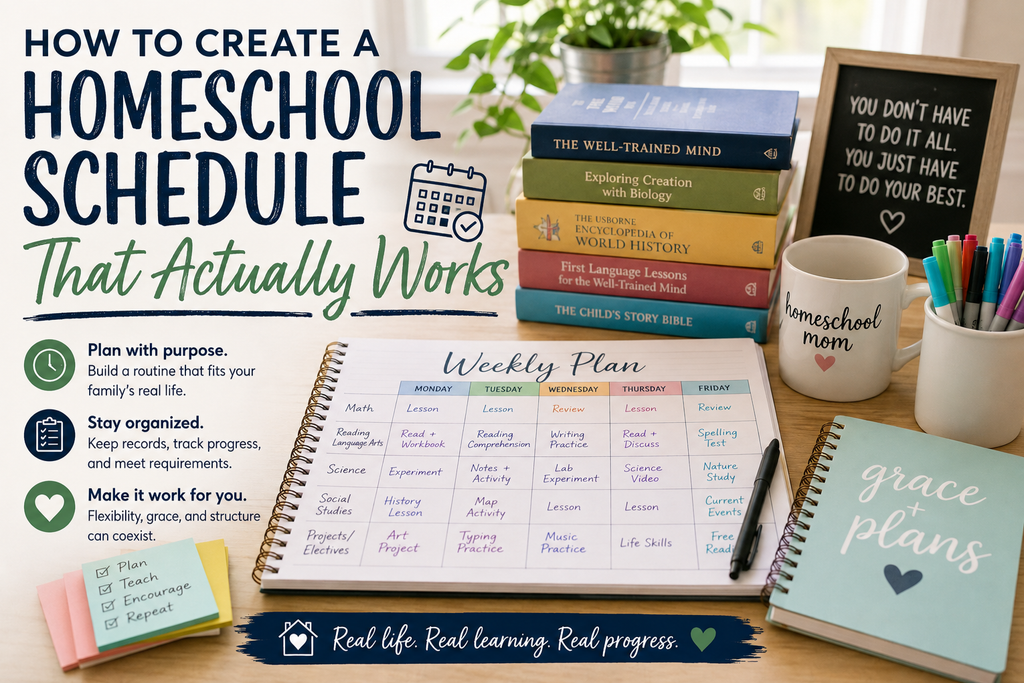
Start With What Your Family Can Realistically Do
Before you start assigning subjects to time slots, look at your actual household.
What time does everyone normally wake up?
When does your child concentrate best?
What work schedules, appointments, activities, or other responsibilities already exist?
Are mornings productive in your house, or does everybody need some time to get moving?
There’s no prize for starting homeschool at 8:00 a.m. if starting at 9:30 makes the entire day run better.
The same goes for trying to copy somebody else’s homeschool routine.
A schedule that works beautifully for a family with three elementary-age children and a stay-at-home parent may make absolutely no sense for a household with a teenager, a working parent, or multiple children at different grade levels.
Build around the family you actually have.
Know Your State’s Homeschool Requirements
Flexibility doesn’t mean there aren’t requirements.
Homeschool laws vary by state, so before building your schedule, check the current requirements where you live. Those requirements may affect subjects, instructional time, attendance records, assessments, reporting, or other parts of your homeschool year.
For example, Georgia home study programs must provide a basic academic educational program that includes reading, language arts, mathematics, social studies, and science. Georgia law also establishes instructional-time requirements for home study programs. Georgia also requires periodic nationally standardized testing beginning at the end of third grade and at least every three years afterward, with the results retained by the parent or guardian.
The important thing isn’t to copy another parent’s schedule from Facebook, Pinterest, or a homeschool blog and assume it meets the requirements where you live.
Know your requirements first.
Then build your schedule around them.
Build Your Core Subjects Into the Week First
Once you understand your state’s requirements, start with the academic foundation.
Put your required subjects and instructional needs into the schedule before filling it with electives, projects, field trips, extracurricular activities, and everything else you’d like to accomplish.
That doesn’t mean every homeschool day has to look identical.
Some lessons will naturally take longer than others. Some subjects may include independent work. Reading can happen in different parts of the day. Projects can cross multiple subjects. A science experiment isn’t necessarily going to fit neatly into a 45-minute box just because that’s what you wrote on the schedule.
Think of your schedule as a framework rather than a stopwatch.
The framework tells you what needs to get done.
Your family determines how you get there.
Stop Trying to Recreate a Traditional School Day at Home
A classroom teacher may be responsible for 20, 25, or 30 students at once.
You aren’t.
Traditional schools also have attendance, announcements, class changes, lunch lines, bathroom breaks, assemblies, classroom management, transportation, and plenty of other things built into the day.
Homeschooling is different.
One-on-one or small-group instruction can often move much more efficiently because you can respond directly to your child’s needs.
If your child understands something, you can move forward.
If your child doesn’t understand it, you can spend more time there.
You don’t have to keep everybody on the same page because there isn’t a classroom full of students waiting.
That’s one of the advantages you have.
Use it.
Think in Blocks Instead of Minutes
One of the easiest ways to make a homeschool schedule feel overwhelming is to plan every minute.
9:00–9:30: Math.
9:30–10:00: Reading.
10:00–10:30: Science.
Then math takes 42 minutes and suddenly the entire schedule looks broken.
Instead, consider organizing the day into larger blocks.
You might have a morning academic block, a break, another instructional block, lunch, and then an afternoon block for additional instruction, projects, reading, electives, or other learning activities.
The exact structure will depend on your family and your state’s requirements.
The advantage is that you’re giving yourself room to move.
If one lesson takes a little longer, you haven’t ruined the day.
Plan the Week, Not Just the Day
A single homeschool day doesn’t tell you much.
The week gives you a better picture.
Maybe Monday was rough, but Tuesday and Wednesday went beautifully. Maybe an appointment interrupted Thursday. Maybe Friday became the perfect opportunity to finish something that needed more time.
Looking at the whole week keeps one imperfect day from feeling like a disaster.
This is where having an actual planning system helps.
A simple weekly plan lets you see what needs to be accomplished without trying to hold the entire homeschool week in your head. If you’d rather have printable pages ready to use, the Homeschool Weekly Planner Pack was designed specifically for organizing homeschool weeks and parent planning.
The tool isn’t the important part.
Being able to see the week is.
Keep Track of What You’ve Actually Completed
Planning and record keeping are two different things.
Your planner tells you what you intend to do.
Your records tell you what actually happened.
That’s an important distinction because homeschool days don’t always follow the original plan.
Maybe you planned three activities and completed two. Maybe a lesson turned into a larger project. Maybe an unexpected educational opportunity replaced what you originally intended to do.
Keep records based on what actually happened rather than trying to make reality match a planner you filled out two weeks ago.
For families who want a dedicated place to track school days, the Homeschool Attendance Tracker Pack provides printable record-keeping forms specifically for that purpose.
That separation between planning and recording can make the entire system easier to manage.
Don’t Let Record Keeping Become Another Full-Time Job
Yes, records matter.
No, you don’t need to spend your entire evening documenting every worksheet your child touched.
Create a simple system and stay consistent with it.
Depending on your family’s needs and your state’s requirements, that might include attendance, assignments, grades, reading, completed work, portfolio materials, assessment results, and periodic progress reviews.
If you track assignments separately, a Homeschool Assignment Log Pack can give you one place to record what’s assigned and what’s completed.
For academic progress, the Homeschool Grade Book & Progress Tracker Pack can help keep grades and progress organized without building your own system from scratch.
Again, these tools should make homeschooling easier.
If your record-keeping system becomes more complicated than the schooling itself, simplify it.
Build Independent Work Into the Routine
As children get older, they should gradually become capable of handling some work independently.
That doesn’t mean handing them a stack of worksheets and disappearing for four hours.
It means teaching them how to take responsibility for appropriate parts of their education.
Maybe they can complete a reading assignment independently.
Maybe they can work through practice problems after you’ve taught the concept.
Maybe they can research part of a project, maintain a reading log, or review vocabulary without you sitting beside them.
A Homeschool Reading Log Pack can also give students a simple way to keep track of books and reading activity.
Independent learning is a skill.
Like any skill, it develops over time.
Leave Room for the Days That Don’t Go According to Plan
Some days simply aren’t going to cooperate.
A child gets sick.
The internet goes down.
The car needs work.
A lesson you expected to be easy turns out to be difficult.
Something unexpected happens in the family.
A schedule with absolutely no breathing room turns every interruption into a crisis.
Build some flexibility into your week from the beginning.
That might mean leaving room for catch-up work, moving an activity, extending a project, or adjusting the workload when something takes longer than expected.
Flexibility isn’t the absence of structure.
It’s structure that can survive real life.
Keep a Portfolio as You Go
If you plan to maintain a homeschool portfolio, don’t wait until the end of the year and try to reconstruct nine months of school from memory.
Save representative work as you go.
That could include writing samples, projects, assessments, reading records, photographs of hands-on activities, completed assignments, or other examples that show progress throughout the year.
You don’t necessarily need to save everything.
You need an organized way to preserve what matters.
The Homeschool Portfolio Checklist Pack can help parents keep track of portfolio materials throughout the year instead of trying to assemble everything at the last minute.
A little organization during the year can save a lot of frustration later.
Review What’s Working Instead of Defending the Original Plan
Your first homeschool schedule probably won’t be your final homeschool schedule.
That’s okay.
After a few weeks, look at what’s actually happening.
Are mornings working?
Is one subject consistently taking longer than expected?
Does your child need more breaks?
Is independent work going well?
Are you constantly moving the same activity to another day?
Those aren’t signs that you’ve failed.
They’re information.
Use them.
Change the schedule when the evidence tells you the schedule needs changing.
And when the year ends, take some time to look at the bigger picture: what worked, what didn’t, where your child grew, what needs more attention, and what you would change next year.
The Homeschool Year-End Review Pack provides printable parent reflection forms for doing exactly that.
Use One System If Too Many Printables Become the Problem
Individual tools are useful when you only need help with one part of your homeschool organization.
But eventually, having six different systems can become its own organizational problem.
If you want planning, attendance, grade tracking, record keeping, and related parent tools together, the Homeschool Parent Tools Mega Bundle combines the parent resources into a larger printable system.
There’s also the 55-Page Homeschool Record Keeping & Attendance Planner for parents who want a single printable organizer built around planning and homeschool records.
You don’t need every organizational tool available.
You need the system you’ll actually use.
A Good Homeschool Schedule Should Make Life Easier
That’s ultimately the test.
Not whether your schedule looks impressive.
Not whether it resembles somebody else’s.
Not whether every day goes exactly according to plan.
A good homeschool schedule helps you meet your responsibilities, keeps your child’s education moving forward, gives you a reliable way to see what’s been accomplished, and still leaves enough flexibility for your family to live its life.
Start with your state’s requirements.
Build around the needs of your child and your household.
Create enough structure to keep everyone moving.
Keep records as you go.
Adjust when something isn’t working.
And don’t confuse a changed plan with a failed plan.
The best homeschool schedule isn’t the one that looks perfect on paper.
It’s the one your family can actually keep using.