

By Christopher Dill
Tom Cruise has spent more than four decades building one of the most recognizable careers in Hollywood.
He has played fighter pilots, spies, lawyers, vampires, and sports agents, but somewhere along the way the work itself became part of the Tom Cruise story. The running. The stunts. The preparation. The insistence on getting the shot. The sense that a movie carrying his name has to deliver.
Listen to enough people talk about working with Tom Cruise, though, and an interesting contradiction appears.
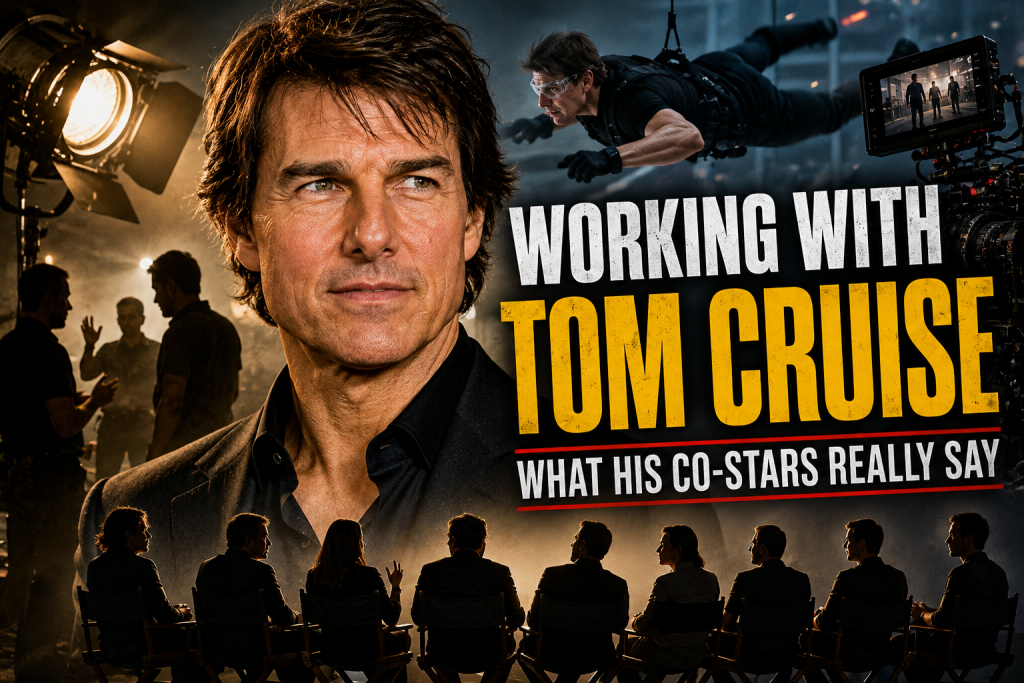
Some describe that intensity as inspiring. Others have found it intimidating, stressful, or simply exhausting. Even people criticizing him often seem to be describing the same basic quality that his admirers celebrate: Cruise takes filmmaking extremely seriously.
That makes the usual “who loves him and who hates him” framing too simple.
The more revealing question is what happens when one actor’s extraordinary drive becomes part of everybody else’s working environment.
Brad Pitt Saw a Fundamental Personality Clash
One of the oldest examples comes from Interview with the Vampire, the 1994 adaptation that put Cruise and Brad Pitt together as Lestat and Louis.
The movie has since generated decades of “feud” headlines, but Pitt’s own comments were more specific than the mythology that grew around them.
Speaking to Premiere after the film, Pitt described the two men as opposites: Cruise was “North Pole” and Pitt was “South.” He said he felt an underlying competition that interfered with real conversation and acknowledged that Cruise sometimes bugged him.
But the same account contained something that tends to disappear when the story is reduced to a celebrity feud.
Pitt said the tension was not nasty, called Cruise a good actor, and said his performance deserved respect. Pitt was also deeply unhappy with the production itself, describing the experience of playing the perpetually miserable Louis for months as something he hated.
That context matters.
Pitt clearly described friction with Cruise, but his comments do not require a decades-long personal war to be interesting. They show two major actors with sharply different temperaments trying to work inside a demanding production.
Thandiwe Newton Experienced the Intensity Very Differently
Thandiwe Newton’s recollection of Mission: Impossible 2 is much more uncomfortable.
Her most memorable example involved a difficult scene on a balcony. According to Newton, Cruise was unhappy with how the scene was working, and the two eventually tried saying each other’s lines.
The exercise was supposed to help.
Newton said it did the opposite, pushing her further into insecurity.
Yet Newton’s description also complicates the easy villain version of the story. She said Cruise was trying hard, that he carried enormous pressure, and that he was stressed. She explicitly said he was not horrible.
That is precisely why her account is so useful.
Newton did not need Cruise to be malicious for the experience to be bad for her. A coworker can be trying desperately to improve a scene and still create an environment another performer finds overwhelming.
Her story is not the opposite of the work-ethic stories about Cruise.
In a way, it is the other side of them.
Mickey Rourke Was Criticizing the Career, Not an On-Set Experience
Not every harsh opinion about Cruise comes from somebody describing what it was like to share a set with him.
Mickey Rourke’s criticism is a good example of why that distinction matters.
During a 2022 interview with Piers Morgan, Rourke dismissed the enormous success of Top Gun: Maverick and argued that Cruise had been doing essentially the same kind of work for decades. Rourke contrasted Cruise with actors he admired for stretching themselves dramatically.
That tells us something about Rourke’s definition of acting and artistic risk.
It does not tell us what Cruise is like as a coworker.
Cruise’s commercial longevity and Rourke’s criticism can both exist without one disproving the other.
The Mark Wahlberg Story Is More Complicated Than the Headline
The Mark Wahlberg episode is an even better example of how celebrity stories can change as they travel.
In 2013, Wahlberg delivered an angry response to the idea that an actor’s work could be compared with military service in Afghanistan. The remarks were widely connected to Cruise because of reporting around a deposition in Cruise’s lawsuit against Bauer Media.
But Cruise himself had not originated the comparison. His attorney had made it.
When Cruise was eventually asked whether the situations were actually the same, he rejected the equivalence.
So the memorable “Wahlberg versus Cruise” version is much cleaner than the actual record.
Wahlberg strongly rejected comparing filmmaking with military service. That is true.
Treating his speech as a direct personal attack on Cruise is much harder to sustain.
Working With Tom Cruise Can Also Mean Finding a Mentor
Move to Glen Powell and the same Cruise intensity looks almost completely different.
After working with Cruise on Top Gun: Maverick, Powell continued turning to him for advice.
When Powell prepared for the physically demanding lead role in The Running Man, he expected a short conversation with Cruise. Instead, Powell has said the call stretched for roughly two and a half hours.
Cruise walked him through lessons accumulated across decades of action filmmaking, including how to approach the physical demands and even how running looks on camera.
Powell has described Cruise as unusually generous with that knowledge—the kind of established star who sends the elevator back down for somebody coming behind him.
It is difficult to square that description with a one-dimensional portrait of Cruise as simply controlling or self-absorbed.
Powell sees the obsessive preparation and receives it as mentorship.
The same habit of thinking through every physical detail that can become intense on a set can also become a valuable library of knowledge when Cruise chooses to share it.
Henry Cavill Saw Just How Far Cruise Will Go
Henry Cavill’s Mission: Impossible – Fallout experience adds another dimension.
Sometimes the people around Cruise are not merely impressed by his commitment. They are watching him do things that appear genuinely alarming.
During the film’s helicopter climax, cast members described reacting in shock as Cruise performed a dangerous-looking drop. Rebecca Ferguson said she initially thought he had fallen, while Cavill remembered an audible gasp from the people watching.
Cavill has also joked about the danger of being in Cruise’s orbit. Discussing the helicopter work, he recalled thinking that if something went wrong, at least being killed by Tom Cruise would make for a memorable headline.
The joke works because Cruise’s stunt reputation is no longer separate from his acting career.
It is part of the product.
The audience is meant to know that the star hanging from, jumping out of, or flying the machine is actually there.
Then the COVID Rant Put Cruise’s Leadership Style on Tape
In late 2020, the public got an unusually raw glimpse of Cruise’s production intensity when audio emerged of him angrily confronting Mission: Impossible crew members over COVID-19 safety protocols.
The language was severe.
The reaction to it was divided.
George Clooney said Cruise was not wrong about the seriousness of the situation, particularly when a shutdown could threaten jobs and an entire production. Clooney also said he personally would not have handled it in exactly the same way.
Alec Baldwin was even more direct in Cruise’s defense. He emphasized Cruise’s understanding of the larger filmmaking apparatus and the many jobs connected to a major production.
Leah Remini saw the recording entirely differently.
The former Scientologist and prominent critic of the Church of Scientology characterized Cruise as abusive and argued that the outburst was about public relations rather than concern for workers.
That remains Remini’s interpretation of the incident, rather than something the recording itself independently establishes.
Those reactions cannot all be collapsed into a single verdict.
Clooney and Baldwin were assessing the production stakes. Remini was interpreting Cruise through her own experiences and perspective.
The recording was the same.
The meaning people assigned to it was very different.
Demi Moore Remembered a Much Smaller, More Human Moment
Not every story about Cruise involves helicopters, shouting, or enormous productions.
In 2025, Demi Moore recalled preparing for A Few Good Men while nearly eight months pregnant. She said she thought Cruise seemed embarrassed and found the situation awkward.
Moore did not present the memory as some major indictment.
She placed it in the culture of early-1990s Hollywood, when pregnancy and an active leading-woman career were not accommodated as routinely as they are today.
The anecdote is revealing precisely because it is ordinary.
Even the hyper-controlled Tom Cruise mythology contains moments of simple human discomfort.
Alec Baldwin May Have Identified the Philosophy Behind It
Years before defending Cruise during the pandemic controversy, Alec Baldwin described asking him what still motivated him after so many years at the top.
Cruise’s answer, according to Baldwin, was that he felt obligated to give people their “money’s worth” on both ends: the people paying him and the people buying tickets.
That idea may explain more about Cruise’s professional reputation than any individual feud story does.
It turns filmmaking into an obligation.
The studio is owed a return.
The audience is owed an experience worth paying for.
Cruise sees himself as responsible for delivering both.
If that is genuinely how he approaches the job, many of the apparently contradictory stories begin to fit together.
The meticulous preparation makes sense.
The stunts make sense.
The impatience when a production is threatened makes sense.
So does the pressure described by Newton.
And so does the admiration expressed by Powell.
And Somehow, There Is Also the Cake
Then there is one of Hollywood’s stranger traditions: the Cruise Cake.
For years, Cruise has sent a white chocolate coconut Bundt cake from a California bakery to friends and colleagues around the holidays. Bakery staff have said he orders hundreds.
The cake has become such a recognizable Hollywood ritual that receiving one is treated almost like membership in an unofficial club.
Cruise has explained that he loves sugar but often cannot eat it while training, so he sends the cake to other people instead.
It is a funny detail, but it belongs in the larger picture.
The man coworkers describe as relentlessly focused on work is also famous for maintaining an elaborate annual gift tradition with people throughout the industry.
There May Not Be Two Tom Cruises After All
It is tempting to look at these stories and conclude that Hollywood cannot agree on Tom Cruise.
Some people find him intimidating.
Some admire him.
Some criticize the kind of movies he makes.
Others call him when they need to learn how to survive making one.
But the accounts may be less contradictory than they first appear.
Again and again, people describe a man operating at an unusually high level of intensity.
Pitt felt an underlying competition. Newton felt pressure. Powell found generosity and mentorship inside that same deep reservoir of preparation. Cavill saw a performer willing to take physical risks that astonished his coworkers. Baldwin heard a star explain his career as a responsibility to both the people financing the movie and the people paying to watch it.
The difference is often not the trait being described.
It is the experience of being around it.
That does not make every criticism unfair, and it does not turn every compliment into proof of sainthood.
It simply leaves us with a more interesting picture than either extreme.
After more than 40 years, Tom Cruise’s reputation inside Hollywood is not built only on being famous, successful, or willing to perform dangerous stunts.
It is built on the intensity with which he approaches the entire job.
For some coworkers, that has been exhilarating.
For others, overwhelming.
And for Cruise himself, if Baldwin’s recollection is the key, it may all come back to one remarkably simple idea:
When people pay for a Tom Cruise movie, he believes he owes them something worth seeing.